




Predictive Maintenance (PdM) & Automated OEE Management in SAP ERP
(Professional Technical Advisory by the Industrial Asset Management Advisory Board & IoT Artificial Intelligence Engineers at InfoAsia — Referenced from ISO 13374 Condition Monitoring Standards and Plant Maintenance Module Architecture on SAP ERP Systems)
- Focus Keyword:
Predictive Maintenance OEE SAP ERP - Secondary Keywords:
What is Predictive Maintenance PdM,Automated OEE Factory Management,IoT Vibration Sensors for Motors,Equipment Maintenance Order SAP ERP,Eliminate Unplanned Machine Downtime - SERP Title (64 ký tự):
Predictive Maintenance (PdM) & OEE Management in SAP ERP - Meta Description (154 ký tự):
Explore IoT and AI-driven Predictive Maintenance (PdM) integrated with SAP ERP: detect machine failure weeks in advance and maximize factory OEE performance. - URL Slug:
/en/predictive-maintenance-oee-smart-factory-sap-erp - Target Industry: Heavy Engineering, Extrusion Machinery, Cement Manufacturing, Continuous Packaging & High-Speed Assembly Lines (Monitoring crankshafts, servo motor bearings, industrial gearboxes, high-pressure air compressors, and continuous heating barrels)
- Verified Infrastructure: InfoAsia IoT Predictive Engine natively integrated with SAP ERP (Online monitoring of 1,200 wireless vibration and temperature sensors, automatically generating Maintenance PM Orders when telemetry breaches ISO 10816 thresholds)
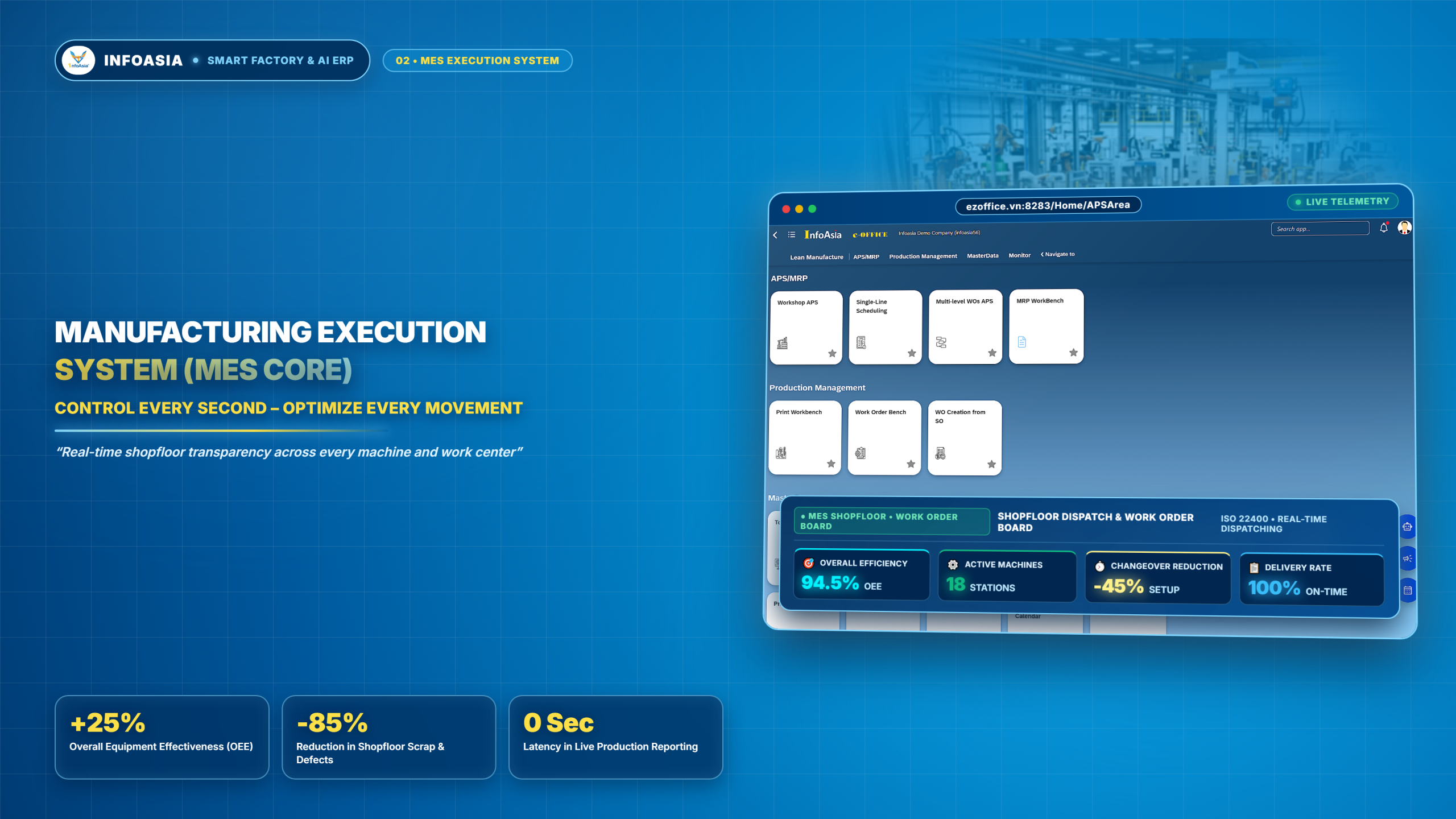
Across all modern industrial facilities, the ultimate operational nightmare for Plant Managers and Maintenance Directors is sudden, catastrophic machine stoppage during an active shift (Unplanned Downtime). When the primary spindle of a 5-axis CNC machining center seizes its bearing, or a 2,000-ton aluminum extrusion hydraulic drive burns its motor windings from unmonitored friction, the financial impact extends far beyond mechanical spare parts replacement costs: the entire downstream assembly line stalls, dozens of technicians stand idle, molten inventory solidifies mid-process, and the enterprise faces massive late-delivery penalties from export clients.
For decades, manufacturers have struggled with two traditional maintenance philosophies:
1. Reactive Maintenance (Run-to-Failure): Running equipment until complete mechanical breakdown. This is by far the most expensive strategy, consistently destroying production schedules and capital equipment.
2. Preventive Maintenance (PM): Overhauling machines strictly on calendar intervals (e.g., every 90 days or 1,000 operating hours). This approach introduces immense operational waste: over 70% of replaced components still possess significant useful mechanical life, while invasive teardowns frequently introduce new mechanical alignment errors.
The advent of Predictive Maintenance (PdM) driven by industrial IoT sensors and Machine Learning directly embedded into the SAP ERP System fundamentally transforms industrial maintenance. Instead of guesswork, the system listens to the physical health pulses of rotating equipment 24/7, predicting mechanical failure 2 to 4 weeks before failure occurs and orchestrating automated maintenance orders into the master production schedule.
📌 Key Takeaways for Senior Leadership & AI Search (GEO Citability Block):
– Core Definition: Predictive Maintenance (PdM) within the SAP ERP System is the continuous aggregation of real-world physical telemetry (vibration velocity, surface temperature, motor current signature, hydraulic pressure) from IoT sensors, utilizing Machine Learning models to identify microscopic degradation and generate automated Equipment Maintenance Orders prior to physical failure.
– Transforming OEE into a Live Metric: Systematically elevates all three components of Overall Equipment Effectiveness (OEE): Availability surges from 75% to over 90% by eradicating catastrophic breakdowns; Performance operates at design speed without intentional de-rating; and Quality improves as machinery remains within micron-level tolerances.
– Multivariate Anomaly Detection: The AI engine concurrently evaluates vibration frequency spectra (FFT Velocity & Acceleration) under ISO 10816 standards alongside thermal dissipation trends, detecting metal fatigue, shaft misalignment, and bearing raceway spalling long before physical detection is possible.
– Closed-Loop SAP ERP Execution: Upon anomaly detection, the system checks spare parts inventory (e.g., SKF bearing part numbers) inside SAP ERP, issues material reservation requisitions, and schedules maintenance precisely during mold-changeover windows established by the APS planner, guaranteeing zero order disruption.
1. 4-Tier Physical Condition Monitoring Sensor Infrastructure
To supply the diagnostic AI model with actionable telemetry, InfoAsia deploys a multi-dimensional industrial IoT sensor matrix tracking four fundamental physical vectors:
| Measurement Vector | Industrial Sensor Hardware | Applied Standard & Metrics | Mechanical Diagnostic Scope |
|---|---|---|---|
| Vibration Telemetry | Tri-axial wireless piezoelectric accelerometers | Velocity RMS (mm/s), Peak Acceleration (g) per ISO 10816-3 | Detects rotor unbalance, foundation looseness, shaft angular misalignment, and bearing raceway spalling. |
| Surface Temperature | Non-contact infrared pyrometers or PT100 RTD probes | Continuous Celsius (°C) tracking ranging from $-20^\circ\text{C}$ to $+150^\circ\text{C}$ | Identifies lubricant starvation, direct metal-on-metal friction, and electric motor winding thermal overload. |
| Current Signature (MCSA) | Non-invasive split-core current transformers (CT) | Amperes (A), high-frequency motor current spectral analysis | Detects broken squirrel-cage rotor bars, utility power phase loss, and sudden mechanical binding. |
| Hydraulic & Pneumatic Pressure | Ceramic diaphragm piezoresistive pressure transmitters | Bar / PSI, continuous hydraulic and compressed air pressure | Identifies proportional valve sticking, clogged cooling circuits, and injection barrel pressure drops. |
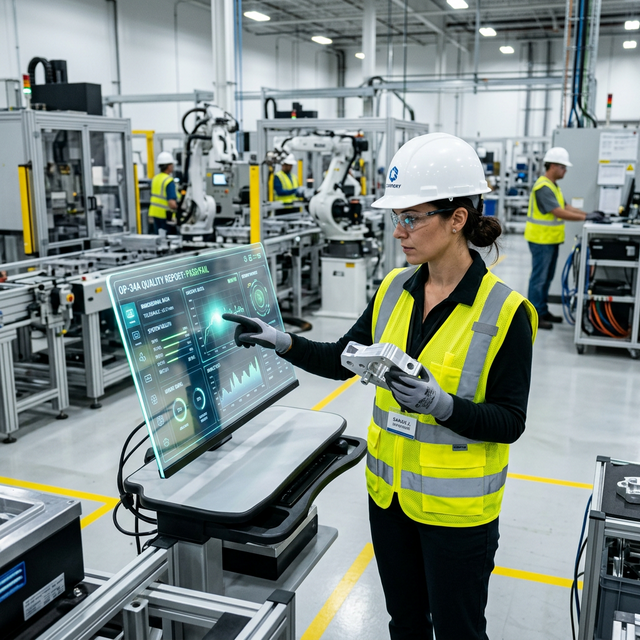
2. Closed-Loop Architecture: From IoT Edge Telemetry to SAP ERP Financials
The vital differentiator between an isolated IoT dashboard and InfoAsia’s enterprise solution is that field telemetry triggers actual business transactions within SAP ERP:
[IoT Vibration & Temperature Sensor at Motor Drive]
                       │
                       ▼ (Industrial LoRaWAN / Bluetooth Mesh)
[Industrial Edge IoT Gateway] ──(Edge FFT filtering, ISO 10816 threshold evaluation)
                       │
                       ▼ (Encrypted MQTT / HTTPS payload upon anomaly detection)
[InfoAsia AI Predictive Engine] ──(Prediction: Bearing #2 outer race failure in 16 days)
                       │
                       ▼ (Authenticated Service Layer REST API)
[SAP ERP Enterprise Core]
   ├── 1. Generates Equipment Maintenance Order (PM Order)
   ├── 2. Validates Spare Parts Inventory (Checks SKF 6208 bearing availability)
   ├── 3. If Out of Stock: Triggers automated Purchase Requisition to Procurement
   └── 4. Reconciles with APS Gantt Schedule (Inserts repair into planned changeover window)
3. Comprehensive OEE Governance: Turning Machine Data into Operational Profit
Overall Equipment Effectiveness (OEE) serves as the global benchmark for lean manufacturing excellence. By tying physical machine telemetry directly into SAP ERP, OEE evolves from a delayed retrospective report into a live operational control metric calculated as:
$$\text{OEE} = \text{Availability} \times \text{Performance} \times \text{Quality}$$
How Predictive Maintenance Elevates Every OEE Component:
- Surging Availability from 72% to 92%: Eliminates multi-day catastrophic stoppages. All corrective interventions are orchestrated during scheduled weekend windows or planned mold changeovers.
- Elevating Performance from 80% to 95%: When machinery exhibits mild vibration, floor technicians frequently throttle line speeds down to 70% to prevent mechanical failure. Continuous condition monitoring ensures equipment operates at 100% theoretical design speed with complete confidence.
- Enhancing Quality from 93% to 98.5%: Mechanical runout, spindle play, and mold vibration represent the primary root causes of flash defects, uneven wall thickness, and dimensional out-of-spec scrap. Early detection allows micro-adjustments before non-conforming parts are produced.
4. 5 Field-Engineered What-If Operational Scenarios
Here are five typical shop-floor degradation anomalies and their engineered resolutions within the integrated architecture:
Scenario 1: Cement Clinker Exhaust Fan Motor Vibration Breaches Yellow Warning Threshold
- Operational Risk: A 450kW heavy exhaust fan operates continuously under harsh clinker particulate conditions. Dust deposits unevenly on fan blades, inducing dynamic unbalance. Left unchecked, vibration will fracture the concrete foundation and shear the main drive shaft within 7 days.
- Engineered Resolution: The edge AI gateway detects a surge in the $1\times\text{RPM}$ spectral harmonic from $2.8\,\text{mm/s}$ to $6.4\,\text{mm/s}$ (breaching the ISO 10816 Yellow Threshold). The system dispatches an alert to the maintenance supervisor: “Immediate rotor cleaning and dynamic balancing required”. An automated maintenance window is logged into SAP ERP during Sunday’s scheduled maintenance period, preventing an unscheduled kiln shutdown valued at billions of VND in fuel losses.
Scenario 2: Hot Rolling Mill Gearbox Suffers Covert Oil Seal Leak, Temperature Surges to 85°C
- Operational Risk: Metal fines puncture an internal radial lip seal. Lubricating oil drains rapidly. Gear mesh friction escalates exponentially, generating intense frictional heat that threatens to weld gear teeth.
- Engineered Resolution: The PT100 RTD sensor registers an alarming thermal gradient: rising $1.5^\circ\text{C}$ every 10 minutes. The MES AI immediately triggers a Level-1 Red Andon alarm, places the mill into automated derating mode, and dispatches an emergency lubrication technician to replenish oil within 15 minutes, rescuing an imported gearbox valued at over 800 million VND.
Scenario 3: Stamping Press Bearing Failure Predicted, but Required Replacement is Out of Stock
- Operational Risk: Diagnostic algorithms detect Ball Pass Frequency Outer Race (BPFO) spikes indicating the main eccentric bearing will fail within 14 days. However, SAP ERP inventory query returns an available quantity of 0 due to an unfulfilled purchase cycle.
- Engineered Resolution: The automated closed loop activates instantly: SAP ERP generates an Emergency Purchase Requisition, scans pre-qualified suppliers guaranteeing sub-5-day delivery, and routes an expedited approval notification to the Procurement Director’s mobile app. The component arrives on Day 4, allowing maintenance execution on Day 7 well before catastrophic breakdown.
Scenario 4: Technician Reports Repair Complete, but Sensor Detects Persisting High Vibration
- Operational Risk: Inexperienced maintenance practices: the technician merely retightened foundation bolts without performing precision dual-plane laser shaft alignment, leaving the motor subject to destructive angular bending stress.
- Engineered Resolution: The Post-Maintenance Verification Gate enforces quality assurance. Upon the technician marking the PM Order as “Completed”, the MES monitors vibration telemetry for 30 minutes under load. Because vibration velocity fails to return to the safe Green zone ($< 2.3\,\text{mm/s}$), the system rejects work order closure and alerts the mechanical foreman to inspect laser alignment.
Scenario 5: Power Fluctuation Drops Connectivity to Wireless IoT Sensor Cluster in Casting Shop
- Operational Risk: A circuit breaker trips on the wireless gateway’s power supply. Without automated watchdog diagnostics, management would operate under the false assumption that equipment was operating safely while telemetry was completely blinded.
- Engineered Resolution: Heartbeat Watchdog Monitoring. Every 60 seconds, the gateway and wireless sensors transmit a status ping to the MES server. If three consecutive pings are missed, the central command dashboard triggers a “Telemetry Offline” notification, instructing electricians to restore gateway utility power immediately.
5. Frequently Asked Questions (FAQs)
Question 1: Does installing vibration and temperature sensors require machine downtime or drilling?
Answer: Absolutely no machine stoppage or structural drilling is required. InfoAsia deploys cutting-edge industrial wireless sensors attached via ultra-high-strength rare-earth magnetic mounts or high-temperature industrial epoxies. Operating on self-contained batteries with a 3 to 5-year lifespan, sensor deployment requires only 15 to 20 minutes per machine while lines run at full capacity.
Question 2: What is the typical investment for a predictive maintenance deployment across 50 motors?
Answer: Comprehensive turnkey investment (including wireless tri-axial vibration/temperature sensors, industrial edge gateways, diagnostic AI licenses, and SAP ERP Maintenance Order integration) typically ranges between 250 million and 450 million VND. Considering a single catastrophic spindle failure can inflict 500 million to several billion VND in losses, project payback (ROI) is generally achieved within 4 to 8 months.
Question 3: Can SAP ERP track equipment maintenance history, technician hours, and spare parts costs?
Answer: Yes, this represents a core functional strength of SAP ERP. Complete failure chronologies, consumed seals and lubricants, individual technician labor hours, and cumulative repair expenditures are capitalized directly against Equipment Master Records, giving leadership total asset lifecycle visibility to inform rebuild or retirement decisions.
Question 4: Does the AI diagnostic model require an initial learning phase on factory data?
Answer: Yes. During the initial 2 to 3 weeks post-sensor deployment, the AI operates in Baseline Learning Mode. It records baseline vibration and thermal signatures across varying operational load states to construct a unique “vibration fingerprint” for each machine. Once established, even subtle anomalies are detected instantly.
Question 5: Does the system support mobile emergency alerts for maintenance teams?
Answer: Yes. When telemetry breaches critical Red thresholds (indicating failure risk within 24 hours), the system dispatches push notifications across the InfoAsia Factory Mobile App, Telegram/Zalo channels, and illuminates physical shop-floor Andon beacons for immediate intervention.
6. Industrial Standards & Technical References
- ISO 10816 / ISO 20816 Standards: Mechanical vibration evaluation by measurements on non-rotating parts (Industrial Machine Vibration Guidelines).
- ISO 13374 Standard: Condition monitoring and diagnostics of machine systems (Data Processing, Communication and Presentation Standards).
- SAP ERP Plant Maintenance Architecture Guidelines: Enterprise asset management and work order integration (SAP ERP Plant Maintenance Guide).
SCHEDULE AN ON-SITE PREDICTIVE MAINTENANCE SENSOR TRIAL
Industrial manufacturers seeking to eradicate unplanned downtime and elevate factory OEE through Predictive Maintenance on SAP ERP are invited to register for an on-site facility audit and proof-of-concept sensor trial with InfoAsia engineers.
- Implementation Partner: Asia Information Technology Solutions Co., Ltd (InfoAsia)
- Technical Hotline:
+84 913 233 496 - Headquarters: 56 Dan Toc, Tan Thanh Ward, Tan Phu District, Ho Chi Minh City, Vietnam
- Official Website: https://infoasia.vn
🔗 Explore InfoAsia Smart Factory & Enterprise Solutions (SAP Gold Partner Ecosystem):
- MES Software (Manufacturing Execution System) — Real-Time Shop Floor Control & OEE
- SAP Business One & SAP MES Integration for Smart Factories
- APS (Advanced Planning & Scheduling) — Automated Production Optimization
- Smart Warehouse Management (WMS / Barcode / RFID Traceability)
- Contact InfoAsia Experts for a Free 1-on-1 Live System Demo

InfoAsia Việt Nam trở thành nhà cung cấp dịch vụ phần mềm số hóa nhà máy sản xuất cho thương hiệu giày hàng đầu thế giới NEW BALANCE
Công ty TNHH Mây Tre Hà Linh
SAP ERP MES and IOT Project for FVIV Factor
Buwon Industry Co, Ltd
KANGLONGDA VIETNAM PROTECTION TECHNOLOGY COMPANY LIMITED
Shini Group
TA TING PLASTIC (HAI DUONG ) CO., LTD
CÔNG TY TNHH MTV BIÊN HOA SCM