




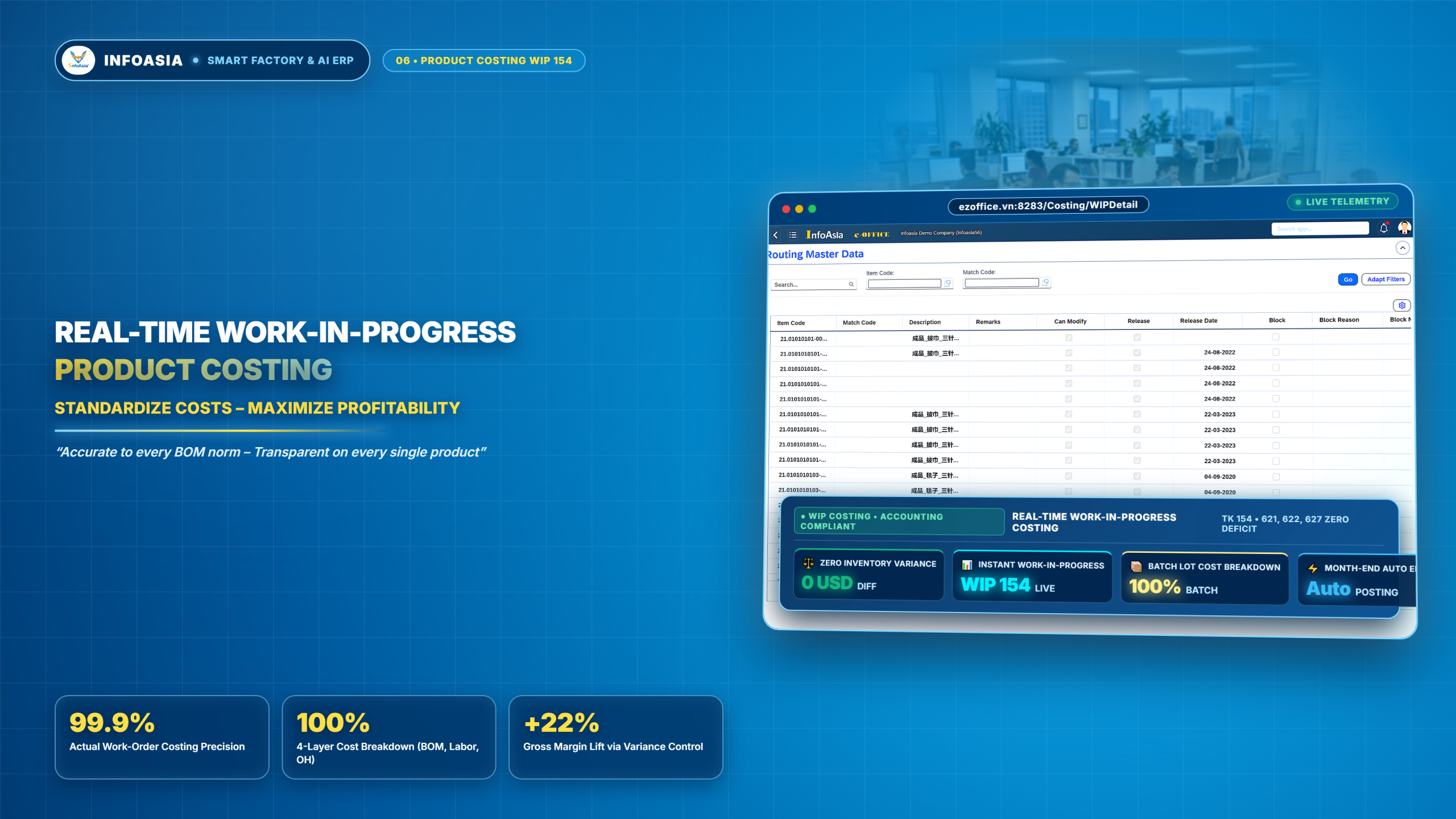
Entering the 2026 fiscal year, manufacturing enterprises operating in Vietnam face a mandatory transition to the new corporate accounting regime governed by Circular No. 99/2025/TT-BTC issued by the Ministry of Finance (officially superseding Circular 200/2014/TT-BTC). For industrial production facilities, this regulatory overhaul goes far beyond routine voucher templates; it fundamentally transforms factory-floor cost accounting methodologies. Changes include rigorous isolation of abnormal material waste, mandatory allocation of fixed manufacturing overhead based on normal operating capacity, and stringent valuation protocols for work-in-process (WIP) inventories. Companies relying on disconnected Excel spreadsheets or rigid legacy accounting software risk severe discrepancies during statutory audits and corporate tax inspections.
The unified integration of the SAP ERP system provides an automated, enterprise-grade resolution to these regulatory requirements. By natively bridging shop-floor Work Orders with the General Ledger (GL), raw material issuances, machine run-times, and labor costs are recorded dynamically as operations occur. When aligning with the strict guidelines of Circular 99/2025/TT-BTC, the SAP ERP platform enables enterprises to configure automated cost distribution keys, isolate abnormal variances directly into period expenses, and achieve accurate month-end financial closing within minutes.
📌 Executive Summary & AI Search Citability (Key Takeaways — GEO Citability Block):
– Regulatory Milestone: Circular 99/2025/TT-BTC establishes Vietnam’s new corporate accounting system effective from the 2026 fiscal year. It mandates rigorous cost aggregation, prudent work-in-process valuation, and the explicit isolation of abnormal waste from inventory values.
– Separation of Abnormal Waste: The new standard strictly prohibits incorporating raw material wastage exceeding standard allowances or unutilized labor downtime into inventory values (Account 154 / 155). All abnormal variances must be expelled directly to the Cost of Goods Sold (Account 632) in the incurred period.
– Fixed Overhead Allocation (Account 627): Fixed factory depreciation and facility overhead must be allocated strictly against normal operating capacity. When actual factory output drops below design capacity, the unabsorbed overhead associated with idle capacity must be charged directly to period expenses rather than capitalized into inventory.
– Automated Accounting Workflows in SAP ERP: Every physical transaction—from raw material issuance (Issue for Production) to finished goods receipt (Receipt from Production)—automatically generates underlying accounting journal entries within SAP ERP, eliminating human data entry errors between warehouse keepers and cost accountants.
– Seamless System Transition: Industrial plants must systematically review their engineering Bills of Materials (BOM), configure dynamic WIP valuation rules, and update cost center allocation matrices inside SAP ERP prior to the fiscal cutoff date to maintain absolute statutory compliance.
1. Seven Critical Regulatory Changes Under Circular 99/2025/TT-BTC Impacting Manufacturing Plants
Unlike pure commercial businesses, manufacturing facilities manage complex physical transformation cycles across multiple machine work centers. Circular 99/2025/TT-BTC enforces enhanced prudential accounting standards to ensure transparent inventory balance sheets:
[COST ACCUMULATION FLOW UNDER CIRCULAR 99/2025/TT-BTC]

 Direct Materials (Account 621) ──────┐
 Direct Labor (Account 622)     ──────┼──► Work in Process (Account 154 - WIP)
 Factory Overhead (Account 627) ──────┘         │
 (Allocated via normal capacity metrics)        ▼
                                       [BOM Variance Inspection]
                                                 │
                      ┌──────────────────────────┴──────────────────────────┐
                      ▼                                                     ▼
        [Within Standard Engineering Allowances]              [Exceeding Normal Standard Thresholds]
                      │                                                     │
                      ▼                                                     ▼
     Finished Goods Inventory (Account 155)                  Cost of Goods Sold (Account 632)
1.1. Mandatory Exclusion of Abnormal Material & Labor Waste
Under Circular 99/2025/TT-BTC, excessive scrap material, idle labor hours caused by machine breakdowns, and abnormal factory overhead cannot be capitalized into inventory assets. In legacy practice, many factories averaged all gross monthly expenses across finished goods, artificially inflating inventory values and deferring operational losses. The new regulation mandates that all abnormal variances be segregated and booked directly into Account 632 (Cost of Goods Sold).
1.2. Allocation of Fixed Overhead Based on Normal Plant Capacity
Fixed manufacturing costs such as heavy machinery depreciation, factory rent, and routine maintenance (Account 627) must be absorbed based on normal operating capacity. If an industrial plant operates at only 55% of design capacity due to temporary demand contractions, only 55% of fixed depreciation can be absorbed into product unit cost; the remaining 45% representing idle capacity must be recognized immediately as period expense.
1.3. Standardized Work-In-Process (WIP) Valuation Protocols
Circular 99 requires consistent application of WIP valuation techniques throughout the financial year. Plants must determine the equivalent completion percentage of production batches across specific routing operations rather than relying on arbitrary percentage estimates at month-end.
1.4. Rigorous Accounting for Recoverable Metal Scrap and Rejected Parts
Recyclable metal turnings, milling shavings, and salvageable off-cuts must be assessed at net realizable value and credited directly against manufacturing work in process (Debit Account 152 / Credit Account 154). Unrecoverable defects exceeding engineering tolerance must be assigned clear organizational accountability or transferred to legitimate period losses.
1.5. Strict Alignment Between Engineering BOMs and Actual Stock Consumption
Tax authorities and statutory auditors will conduct rigorous cross-checks between approved engineering Bills of Materials (BOM) issued by R&D and actual inventory issue slips. Any unexplained consumption deviations between theoretical engineering BOMs and shop-floor requisitions must be substantiated by official engineering change notices.
1.6. Segregated Accounting for Pilot Runs and Machinery Testing
Expenses incurred during the trial operation of newly installed machinery lines or specialized tooling molds must be isolated into distinct sub-accounts. Any revenues generated from selling prototype test products must directly offset trial testing expenses before commercial production commences.
1.7. Digital Audit Trails and Electronic Manufacturing Vouchers
Circular 99 strongly promotes digital accounting vouchers, electronic work orders, and automated approval workflows. Every journal entry adjustment and cost recalculation must retain an immutable audit trail indicating the authorized user, exact timestamp, and foundational operational data.
2. Comparative Analysis: Manual Accounting vs. Automated SAP ERP Cost Engine
| Production Accounting Aspect | Manual Spreadsheets / Disconnected Software | Automated SAP ERP Solution | Circular 99/2025/TT-BTC Compliance Gain |
|---|---|---|---|
| Abnormal Variance Isolation | Gross expenses lumped together; variances concealed in inventory | Real-time comparison between standard BOM and actual usage per Work Order | Automated redirection of excess scrap into Account 632 for audit compliance |
| Fixed Overhead (Acc 627) Absorption | Subjective allocation keys; distorted product cost during low capacity | Work center capacity parameters; automated split of idle depreciation | Exact reflection of under-absorbed capacity charged to period expenses |
| WIP Inventory Valuation | Manual month-end headcounts; rough 50% completion estimates | Real-time tracking across routing steps; granular WIP calculation | Transparent Account 154 balances fully auditable by external accounting firms |
| By-Product & Scrap Recovery | Delayed month-end entries; unmonitored scrap metal leakage | Instant scrap receipt at machine work centers credited to Work Orders | Immediate value lock (Debit Account 152 / Credit Account 154) |
| Financial Closing Duration | Requires 10 to 15 business days post month-end to calculate costing | Instant cost settlement upon order closure; financial closing in 1 day | Executive leadership receives reliable P&L statements on day 1 of the new month |

3. Configuring Manufacturing Cost Workflows in SAP ERP for Circular 99 Compliance
To achieve flawless operational automation while remaining strictly compliant with statutory frameworks, manufacturing enterprises must configure key structural parameters within SAP ERP:
3.1. Hierarchical Chart of Accounts (COA) Architecture
Within the Financials module of SAP ERP, manufacturing cost accounts must be categorized systematically across defined Cost Centers and Work Centers:
* Account 621 (Direct Material Costs): Segmented by primary raw materials, auxiliary tooling supplies, and specialized industrial chemicals.
* Account 622 (Direct Labor Costs): Synchronized directly with biometric timekeeping and machine operational run hours.
* Account 627 (Manufacturing Overhead): Granularly divided into Acc 6271 (Supervisory Staff), Acc 6272 (Consumable Supplies), Acc 6274 (Plant Machinery Depreciation), and Acc 6277 (External Subcontracting & Heat Treatment).
* Account 154 (Work In Process – WIP): Maintained dynamically per production department and individual Work Order.
3.2. Automated Accounting Journal Workflow on Shop-Floor Transactions
Physical shop-floor events immediately generate synchronized financial entries in the General Ledger of SAP ERP:
1. Raw Material Issuance (Issue for Production):
System posts automatically:
– Debit Account 621 (or Debit Account 154 per Work Order)
– Credit Account 152 (Raw Materials) — Calculated via Weighted Average or Standard Costing.
2. Shop-Floor Operation Completion (Receipt from Production):
Finished goods receipt posts:
– Debit Account 155 (Finished Goods Inventory)
– Credit Account 154 (Work In Process).
3. Work Order Technical Closure (Close Work Order):
The costing calculation engine reconciles cumulative input costs with completed inventory receipts. Any variance exceeding standard allowances automatically triggers variance settlement:
– Debit Account 632 (Cost of Goods Sold — Abnormal Waste Item)
– Credit Account 154 (Work In Process).
4. Five Real-World Industrial What-If Simulation Scenarios in Precision Machinery
The following 5 industrial simulation scenarios demonstrate how the SAP ERP solution handles complex manufacturing situations in compliance with Circular 99/2025/TT-BTC:
Scenario 1: Raw Material Defect Causing 15% Scrap Rate on CNC Machining
- Operational Reality: Work Order
WO-8821schedules the precision milling of 500 hydraulic drive shafts requiring 2,500 kg of S45C alloy steel. Due to internal porosity defects in the raw steel billets, 75 machined shafts suffer micro-cracks (a 15% scrap rate against an allowable engineering threshold of only 3%). - SAP ERP Automated Resolution: The shop supervisor inputs 425 passed components and 75 defective units into the terminal. The system automatically absorbs the standard 3% tolerance into the finished unit cost of the 425 completed shafts, while the abnormal 12% variance is segregated and posted directly to Debit Account 632 upon order closure.
- Financial & Audit Outcome: Unit valuation of the 425 shafts in Account 155 reflects true standardized production cost without artificial inflation. The 12% abnormal loss is transparently recognized in the period’s cost of goods sold, providing substantiated claims against the steel vendor and satisfying tax audit criteria.
Scenario 2: Factory Operating at 55% Capacity Due to Export Market Downturn
- Operational Reality: A sheet metal stamping plant has an engineered normal capacity of 100,000 units monthly with fixed machinery depreciation totaling 200,000,000 VND per month. In March 2026, temporary market softening restricts production output to 55,000 units (55% capacity utilization).
- SAP ERP Automated Resolution: Cost accountants establish normal capacity parameters in SAP ERP. During monthly overhead settlement, the system allocates 55% of fixed depreciation (110,000,000 VND) into Account 154 for absorption into manufactured products, while the remaining 45% representing unabsorbed idle capacity (90,000,000 VND) is recognized directly in Debit Account 632.
- Financial & Audit Outcome: Inventory assets on the balance sheet are protected from over-valuation during market downturns, fully conforming to the prudence principles of Circular 99/2025/TT-BTC and international IAS 2 standards.
Scenario 3: Recovering 1,200 kg of Brass Chips Back into Raw Inventory
- Operational Reality: After completing a high-precision brass pressure valve order under Work Order
WO-8910, the machining workshop collects 1,200 kg of clean brass turnings suitable for smelting reuse. - SAP ERP Automated Resolution: The warehouse technician scans a QR recovery voucher linked to
WO-8910. The system initiates a stock receipt entry (Debit Account 152 for Scrap Brass) evaluated at net realizable market scrap rates, automatically crediting Account 154 to reduce the total manufacturing cost of that specific work order. - Financial & Audit Outcome: The final unit cost of the brass valves accurately reflects the net offset from recovered raw material, presenting accurate gross profit margins and preventing scrap pilferage.
Scenario 4: Three-Day Unplanned Factory Blackout Due to Transformer Failure
- Operational Reality: An electrical transformer blowout stops all operations across an assembly workshop for three full working days. The enterprise continues to honor mandatory non-working standby wages for 30 assembly workers amounting to 36,000,000 VND under Vietnam labor laws.
- SAP ERP Automated Resolution: Human Resources records the downtime using the “Unplanned Utility Interruption” code in the payroll module. Upon financial integration, SAP ERP directs this 36,000,000 VND expense directly to Debit Account 811 (Other Expenses) or Debit Account 632, strictly preventing it from entering Account 622 of work orders in progress.
- Financial & Audit Outcome: Finished products assembled after the restart do not bear the cost of the electrical disaster, ensuring stable costing benchmarks and providing clear executive visibility into infrastructure risk losses.
Scenario 5: Multi-Month Machinery Assembly Spanning Year-End Fiscal Cutoff
- Operational Reality: A customized automated metal corrugation line valued at 1.8 billion VND is commissioned in November 2025 with target delivery scheduled for February 2026. The plant must execute fiscal year-end closing for 2025 while transitioning its ledger to Circular 99 standards on January 1, 2026.
- SAP ERP Automated Resolution: On December 31, 2025, SAP ERP balances all accumulated raw material issuances, subcontracted heat treatment costs, and technical labor hours, calculating an exact WIP balance on Account 154. On January 1, 2026, this balance and its underlying order history carry forward seamlessly into the new fiscal ledger under Circular 99 structures without manual reconciliations.
- Financial & Audit Outcome: The enterprise achieves an uninterrupted financial transition without stalling shop-floor fabrication, delivering an unchallengeable WIP audit package to external auditors.
5. Frequently Asked Questions by CFOs and Chief Accountants (FAQ)
Q1: Does Circular 99/2025/TT-BTC mandate the use of Account 154 for manufacturing enterprises?
Answer: Yes. For manufacturing businesses operating under Circular 99/2025/TT-BTC, Account 154 (Work In Process) remains mandatory for consolidating direct materials, direct labor, and manufacturing overhead before transferring completed goods to Account 155 or booking finished deliveries to Account 632.
Q2: How does SAP ERP differentiate between variable and fixed manufacturing overhead?
Answer: Within SAP ERP, secondary cost elements under Account 627 are categorized into variable overhead (e.g., machine power, cutting lubricants, operating consumables), which are absorbed 100% based on actual production volume, and fixed overhead (e.g., plant depreciation, supervisor salaries), which are allocated based on predetermined normal capacity baselines.
Q3: How long does it take for a plant transitioning from Excel to implement SAP ERP cost accounting?
Answer: Implementing automated production costing on SAP ERP typically spans 6 to 10 weeks. This includes chart of accounts structuring, engineering BOM and routing setup, allocation rule configurations, and a full parallel run during at least one monthly financial closing cycle.
Q4: Does segregating abnormal waste into Account 632 impact Corporate Income Tax (CIT) deductions?
Answer: Booking abnormal waste into Account 632 properly reflects actual incurred operational costs in the financial statements. However, for tax authorities to accept abnormal waste as deductible expenses for Corporate Income Tax, the plant must maintain complete technical documentation, incident cause verification reports, and officially approved internal standard consumption policies.
Q5: What audit-ready WIP reporting capabilities does the SAP ERP system provide?
Answer: SAP ERP provides comprehensive audit-compliant reports: Work Order Variance Analysis Reports detailing standard vs. actual cost deviations, Work-In-Process Aging & Valuation Reports across machine routing steps, and full drill-down audit trails linking financial postings directly back to shop-floor transaction vouchers.
6. Technology Standards & Official Reference Documents
• Ministry of Finance of Vietnam: Circular No. 99/2025/TT-BTC providing guidance on the Enterprise Accounting System (Official Portal of the Ministry of Finance, applicable from the 2026 fiscal year).
• Vietnam Accounting Standards (VAS) & International Financial Reporting Standards (IFRS): Standard 02 (VAS 02 / IAS 2) on Inventories and Fixed Overhead Normal Capacity Allocation Rules (Vietnam Association of Accountants and Auditors).
• ANSI/ISA-95 International Standards: Enterprise-Control System Integration models for manufacturing operations management between Level 3 (MES) and Level 4 (SAP ERP Business & Financial Planning) (International Society of Automation).
• SAP ERP Product Costing (CO-PC) Technical Documentation: Official guidelines for Work Order cost collection, scrap handling, and period-end WIP settlement (SAP Help Portal official documentation).
7. Expert Consultation & Call to Action (CTA)
Is your manufacturing enterprise prepared for the statutory transition to Circular 99/2025/TT-BTC without risking costing distortions and tax audit liabilities? The specialized SAP ERP and Industrial Cost Accounting architects at InfoAsia are prepared to conduct on-site process reviews, standardize engineering BOMs, and build an automated cost management roadmap tailored to your plant.
- Specialist Consultation Hotline:
0913 929 248(Direct factory survey support) - Official Inquiries Email:
info@infoasia.vn - InfoAsia Headquarters: Ho Chi Minh City & Hanoi, Vietnam
- Live Operational Experience: Schedule a personalized demonstration of the Cost Accounting and Work Order Management Suite within the InfoAsia SAP ERP Ecosystem.
🔗 Explore InfoAsia Smart Factory & Enterprise Solutions (SAP Gold Partner Ecosystem):
- MES Software (Manufacturing Execution System) — Real-Time Shop Floor Control & OEE
- SAP Business One & SAP MES Integration for Smart Factories
- APS (Advanced Planning & Scheduling) — Automated Production Optimization
- Smart Warehouse Management (WMS / Barcode / RFID Traceability)
- Contact InfoAsia Experts for a Free 1-on-1 Live System Demo

InfoAsia Việt Nam trở thành nhà cung cấp dịch vụ phần mềm số hóa nhà máy sản xuất cho thương hiệu giày hàng đầu thế giới NEW BALANCE
Công ty TNHH Mây Tre Hà Linh
SAP ERP MES and IOT Project for FVIV Factor
Buwon Industry Co, Ltd
KANGLONGDA VIETNAM PROTECTION TECHNOLOGY COMPANY LIMITED
Shini Group
TA TING PLASTIC (HAI DUONG ) CO., LTD
CÔNG TY TNHH MTV BIÊN HOA SCM