




Key Takeaways:
- Next-Generation IT/OT Convergence in 2027: The 2026–2027 industrial landscape marks a decisive shift from passive transaction logging to proactive ERP AI, MES AI, and industrial IoT architectures that predict shop-floor bottlenecks in real time.
- Autonomous Finite Scheduling with APS: Instead of relying on fragmented manual spreadsheets, APS (Advanced Planning and Scheduling) embedded within modern MES Software dynamically optimizes finite capacity across machines, tooling, and skilled labor.
- Closed-Loop Shop-Floor to Finance Integration: Every PLC pulse count and workstation declaration captured by Production Management Software is validated and synchronized bi-directionally with SAP ERP via SAP Business One Service Layer RESTful APIs.
- Supply Chain Agility via Digital Twins: When rush export orders or raw material disruptions occur in 2027, MES AI simulation engines allow production planners to evaluate What-If rescheduling scenarios within minutes.
- Enterprise Governance & Cost Transparency: Role-based access controls and automated electronic audit trails empower plant executives to track multi-level Bill of Materials (BOM) scrap variances and actual work-order costing with 100% precision.
1. The 2027 Manufacturing Landscape: From Isolated Digitization to Autonomous MES AI Factories
As manufacturing enterprises in Vietnam across precision engineering, technical plastics, electronics assembly, packaging, and textiles enter the 2027 planning horizon, they face dual competitive pressures: global buyers demand shorter delivery lead times while enforcing strict batch traceability and energy-efficiency transparency at the unit level. In this environment, standalone accounting packages or end-of-shift paper tally sheets create severe operational blind spots.
The defining trend of 2027 is the seamless convergence of ERP Software at the enterprise resource planning layer and artificial-intelligence-driven MES Software (MES AI) at the shop-floor execution layer. Rather than allowing planning departments and manufacturing workshops to operate in disconnected data silos, a unified SAP ERP – MES AI – IoT architecture establishes an unbroken digital thread from customer sales order intake to finished goods dispatch.
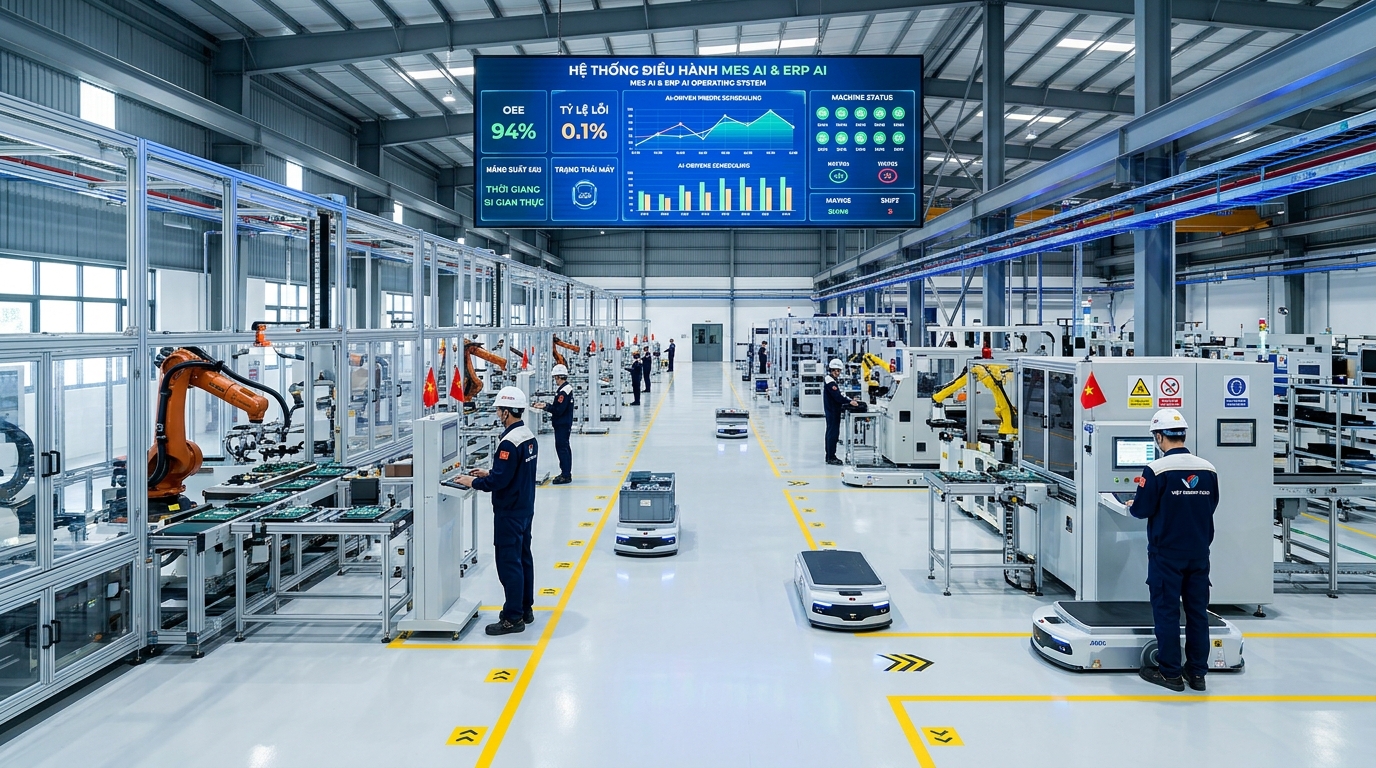
According to official technical specifications from the SAP Help Portal and Boyum IT – Beas Manufacturing, a future-ready manufacturing execution platform must resolve three core shop-floor imperatives:
- Real-Time Resource Visibility: Instantaneous tracking of which work centers are Running, in Setup/Changeover, or experiencing Unplanned Downtime.
- In-Line BOM & Scrap Governance: Real-time reconciliation of actual material consumption against multi-level BOM (Bill of Materials) standards at every Routing operation.
- Predictive Analytics & Dynamic Rescheduling: Combining historical shop-floor telemetry (MES AI) with finite APS algorithms to flag potential delivery delays early and recommend optimal shift or machine reallocations.
2. Comparing Three Generations of Factory Management: Manual, Standalone ERP, and the 2027 ERP AI + MES AI Ecosystem
To help Chief Executive Officers and Plant Directors benchmark their digital maturity for 2027, the table below compares operational capabilities across three management paradigms:
| Operational Dimension | Generation 1: Manual Management (Spreadsheets & Paper Logs) | Generation 2: Standalone ERP Software (No Shop-Floor MES/IoT) | Generation 3: SAP ERP + MES AI + APS + IoT Ecosystem (2027 Standard) |
|---|---|---|---|
| Shop-Floor Output & Scrap Capture | Operators fill out paper tickets at shift end; clerks re-key data the next day. | Post-production backflushing upon work order closure; 8-to-24-hour visibility lag. | IoT PLC pulse counters and MES AI shop-floor terminals capture output second-by-second. |
| Production Scheduling | Manual scheduling based on planner intuition; frequent machine and mold conflicts. | MRP assumes infinite capacity and static lead times without real machine constraints. | APS calculates finite capacity across machines, auxiliary tooling/molds, and operator skill matrices. |
| Work-in-Progress (WIP) Visibility | Blind spots between routing steps; requires physical floor freezes to count WIP. | Tracks raw material warehouse and final finished goods receipt only. | 100% live QR/RFID lot tracking across every intermediate work center and buffer zone. |
| Overall Equipment Effectiveness (OEE) | Subjective estimates or delayed manual summaries missing micro-stoppages. | Lacks granular cycle-time telemetry and standardized downtime reason codes. | Automated MES AI dashboards calculate real-time Availability x Performance x Quality. |
| Actual Production Costing | Monthly close delayed by 10–15 days; overhead allocated via rough averages. | Captures material issues per order but lacks exact operation-level machine/labor hours. | Direct synchronization of actual labor, machine hours, and scrap from MES Software to SAP ERP General Ledger under Circular 200/2014/TT-BTC. |
3. Five Technological Pillars Shaping Smart Factories in 2026 – 2027
3.1. ERP AI: Predictive Demand Forecasting and Intelligent MRP
In 2027, ERP AI extends far beyond transactional bookkeeping. By applying time-series analytics to historical order patterns and supplier lead-time variability, SAP ERP empowers procurement and planning teams to detect raw material shortage risks ahead of seasonal peaks, optimizing safety stock buffers without tying up excessive working capital.
3.2. MES AI & Industrial IoT: Real-Time OEE and In-Process Quality Control
On the factory floor, MES & Industrial IoT Production Management Software serves as the operational nerve center. Via industrial protocols (OPC UA, Modbus TCP, MQTT), telemetry from CNC machining centers, injection molding presses, and automated assembly lines feeds directly into plant Andon boards and MES AI analytics engines. When defect rates or cycle-time deviations cross Statistical Process Control (SPC) thresholds, real-time alerts notify QC engineers to intervene immediately at the source.
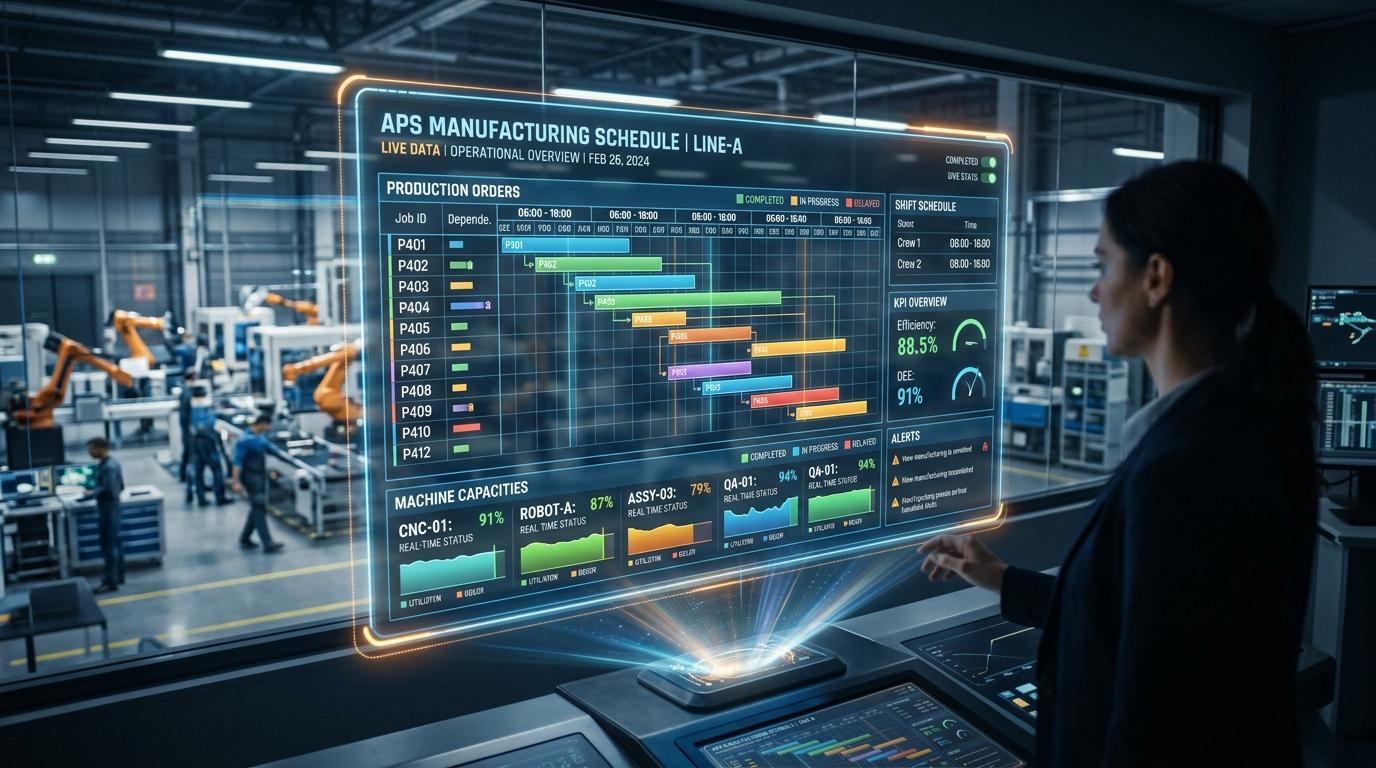
3.3. APS (Advanced Planning & Scheduling): Solving Multi-Constraint Optimization
A production order can only execute smoothly when four physical constraints align simultaneously: Available Machine + Ready Mold/Tooling + Staged Raw Materials + Certified Operator. The APS engine within InfoAsia’s Cloud ERP – MES Integration Architecture leverages forward and backward finite scheduling algorithms to synchronize these four constraints, minimizing setup changeover times by grouping orders with shared tooling characteristics.
3.4. Synchronized Workforce Attendance and Piece-Rate Productivity
Skilled workers remain at the heart of the 2027 Smart Factory. By linking employee attendance and qualification records from the HR & Payroll Management System directly with shop-floor MES Software terminals, plant managers enforce certified skill-matrix assignments during shift dispatching while automating piece-rate incentives and overtime calculations with full transparency.
4. Five Real-World ERP AI & MES AI Factory Scenarios (What-If Simulation)
- [Illustrative Simulation Scenario – What-If Simulation] Handling an Urgent Export Order in a Precision CNC Machining Plant:
- Context: An FDI customer requests an expedited batch of 3,000 CNC milled components delivered within 5 working days while all 12 machining centers are fully booked.
- ERP AI + MES AI Resolution: The Production Planner runs a What-If simulation in APS. The engine identifies lower-priority work orders with sufficient slack time, proposes automated lot splitting across three 5-axis CNC centers, and recalculates accurate delivery timestamps for every affected order in under 3 minutes.
- [Illustrative Simulation Scenario – What-If Simulation] Predictive Progressive Die Maintenance via IoT & MES AI:
- Context: Sheet-metal progressive stamping dies experience cutting-edge wear after high stroke counts, generating burrs that cause downstream welding defects.
- ERP AI + MES AI Resolution: An IoT stroke counter mounted on the stamping press streams real-time cycle counts to MES Software. Once cumulative strokes reach 95% of the die’s preventive maintenance threshold, MES AI blocks over-scheduling of that tool and triggers an automated maintenance work order for the tooling room.
- [Illustrative Simulation Scenario – What-If Simulation] Preventing Expired Resin Issuance in Plastics & Packaging Manufacturing:
- Context: A raw material warehouse holds hundreds of polymer resin and additive bags across multiple batches, risking accidental issuance of newer lots while older lots expire.
- ERP AI + MES AI Resolution: When warehouse operators scan pallets via handheld PDA terminals against SAP ERP pick lists, the system enforces FEFO (First Expired, First Out) validation. Scanning a non-compliant batch triggers an immediate visual and audio block on the terminal.
- [Illustrative Simulation Scenario – What-If Simulation] Dynamic Crew Rebalancing During Unexpected Shift Absences:
- Context: At the start of the morning shift, 6 injection-molding operators report unexpected sick leave, threatening to stall 4 priority production runs.
- ERP AI + MES AI Resolution: Live gate attendance from the HR module syncs instantly with the MES AI dispatch board. The system cross-references the plant Skill Matrix of present workers and recommends reassigning 4 certified Level-3 cross-trained operators from secondary packaging lines to keep the bottleneck molding presses running.
- [Illustrative Simulation Scenario – What-If Simulation] End-of-Period Standard vs. Actual Cost Variance Analysis:
- Context: Executive leadership notices a 3.5% gross margin drop on electrical enclosure products compared to annual standard cost budgets, without clarity on whether purchasing prices or shop-floor inefficiencies caused the variance.
- ERP AI + MES AI Resolution: Integrated variance reporting between SAP ERP and MES AI reveals that raw material purchase prices rose only 0.4%, whereas actual machine runtime at the powder-coating line exceeded Routing standards by 18% due to conveyor hanger starvation—enabling targeted engineering corrective action the very next week.

5. A Practical 4-Stage Roadmap for Implementing ERP AI & MES AI in 2027
To ensure measurable Return on Investment (ROI) and smooth shop-floor adoption in 2027, manufacturing enterprises should execute a phased 4-stage rollout:
- Stage 1 – Master Data Governance: Standardize item master catalogs, multi-level Bills of Materials (BOM), operation Routings, work center capacities, and standard labor/machine cost rates inside SAP ERP.
- Stage 2 – QR/RFID Warehouse & Shop-Floor Traceability (WMS & WIP): Deploy barcode/RFID lot scanning from Goods Receipt PO (GRPO) and material staging through intermediate work-in-progress (WIP) declarations on MES Software terminals.
- Stage 3 – Industrial IoT Connectivity & Finite APS Scheduling: Connect PLC/sensor IoT gateways at bottleneck work centers for automated OEE tracking and activate daily finite-capacity APS scheduling.
- Stage 4 – AI-Driven Optimization (ERP AI & MES AI): Leverage clean historical execution data to power predictive material planning, predictive equipment maintenance, and real-time actual cost variance analytics.
6. Frequently Asked Questions (FAQ) on 2027 ERP AI & MES AI Trends
Q1: If our factory already runs SAP ERP, do we still need dedicated MES AI Software?
Answer: Yes. SAP ERP governs enterprise-level resource planning (Finance, Procurement, Sales, Inventory, and master MRP), whereas MES AI Software manages minute-by-minute shop-floor execution—including finite APS scheduling, PLC/IoT machine telemetry, in-process quality control (IQC/PQC/OQC), and real-time WIP lot genealogy. Together, they form a complete closed-loop architecture.
Q2: Can legacy CNC machines and older mechanical presses be connected to an IoT and MES AI platform?
Answer: Absolutely. Modern CNC controllers connect natively via OPC UA or Modbus TCP. For legacy mechanical presses or older equipment lacking network ports, engineers install non-invasive Edge IoT Gateways paired with optical sensors, current transformers (CT), and station HMI tablets to digitize 100% of run/down states and cycle counts.
Q3: What is the fundamental difference between traditional MRP scheduling and APS scheduling in MES AI?
Answer: Traditional MRP calculates material requirements assuming infinite machine capacity and fixed lead times. Conversely, APS (Advanced Planning and Scheduling) computes schedules using finite capacity—simultaneously evaluating real-time machine availability, mold/tooling constraints, and operator skill matrices to produce a 100% executable shop-floor schedule.
Q4: How does MES AI shop-floor data integration comply with Vietnamese accounting standards in SAP ERP?
Answer: Every raw material issue, direct labor hour declaration, machine depreciation allocation, and Work-in-Progress (Account 154) valuation synchronized from the MES layer into SAP ERP is mapped in strict compliance with Circular 200/2014/TT-BTC issued by the Vietnam Ministry of Finance.
Q5: How long does it typically take to deploy an integrated SAP ERP and MES AI system for a mid-to-large factory?
Answer: Depending on routing complexity (discrete vs. process manufacturing) and BOM master-data readiness, a structured phased implementation typically takes 3 to 6 months to achieve core Go-Live and scale IoT connectivity across the shop floor.
7. Official Technical & Regulatory References
- Enterprise ERP Technical Documentation: SAP Business One Help Portal – Production Module, Bill of Materials (BOM), Material Requirements Planning (MRP) & Service Layer API (
https://help.sap.com/docs/SAP_BUSINESS_ONE). - MES & APS Execution Documentation: Boyum IT Solutions – Beas Manufacturing Documentation: Advanced Planning and Scheduling (APS), Shop-Floor Data Collection (FDC) & Quality Control (
https://www.boyum-solutions.com/solutions/production/beas-manufacturing). - Vietnamese Cost Accounting Regulation: Circular No. 200/2014/TT-BTC dated December 22, 2014 by the Ministry of Finance guiding the Corporate Accounting Regime (Work-in-Progress Account 154 and Production Costing principles).
🔗 Explore InfoAsia Smart Factory & Enterprise Solutions (SAP Gold Partner Ecosystem):
- MES Software (Manufacturing Execution System) — Real-Time Shop Floor Control & OEE
- SAP Business One & SAP MES Integration for Smart Factories
- APS (Advanced Planning & Scheduling) — Automated Production Optimization
- Smart Warehouse Management (WMS / Barcode / RFID Traceability)
- Contact InfoAsia Experts for a Free 1-on-1 Live System Demo

InfoAsia Việt Nam trở thành nhà cung cấp dịch vụ phần mềm số hóa nhà máy sản xuất cho thương hiệu giày hàng đầu thế giới NEW BALANCE
Công ty TNHH Mây Tre Hà Linh
SAP ERP MES and IOT Project for FVIV Factor
Buwon Industry Co, Ltd
KANGLONGDA VIETNAM PROTECTION TECHNOLOGY COMPANY LIMITED
Shini Group
TA TING PLASTIC (HAI DUONG ) CO., LTD
CÔNG TY TNHH MTV BIÊN HOA SCM