




As the 2026 fiscal year draws to a close on Thursday, December 31, 2026, executing an accurate year-end inventory audit and calculating Work-in-Progress (WIP — Account 154 under Vietnamese Accounting Standards) becomes the single most critical operational milestone for factory directors, chief accountants, and plant managers. Even minor discrepancies in shop-floor raw materials or unrecorded production orders halfway through machining lines can delay audited financial statements and trigger tax compliance risks.
Key Takeaways (Executive Summary for Plant Directors & CFOs):
- 2026 Fiscal Cut-Off Date: The official inventory movement cut-off falls at the end of Thursday, December 31, 2026, right before the 3-day Gregorian New Year long weekend (
Friday, Jan 1, 2027toSunday, Jan 3, 2027).- The #1 Audit Bottleneck: Physical count errors rarely happen in the main warehouse; they occur in semi-finished Work-in-Progress (WIP) scattered across shop-floor work centers that have not yet been keyed into Excel spreadsheets.
- MES AI & QR/RFID WMS Automation: Scanning batch/serial barcodes and RFID tags directly at each routing step captures a real-time Point-in-Time WIP Snapshot without shutting down production lines for days.
- Seamless Financial Reconciliation: Shop-floor execution data from InfoAsia MES AI & Industrial IoT synchronizes directly with the Cost Accounting ledger in SAP ERP in full compliance with Circular 200/2014/TT-BTC.
- 80% Faster Year-End Closing: Enables manufacturing plants to finalize physical inventory sheets and WIP costing within 24 hours instead of 5–7 days of manual reconciliation.

1. Why Do Factory Year-End Inventory Audits and WIP Counts Consistently Drift?
In retail or distribution businesses, a year-end inventory audit simply involves counting static goods sitting on warehouse shelves. In manufacturing plants (Injection Molding, CNC Precision Machining, Packaging, Garments, Electronics, or Food & Beverage), materials flow continuously every minute from Raw Material Warehouses (Account 152) into Shop-Floor Work-in-Progress (Account 154) and finally into Finished Goods (Account 155).
When factories rely on paper tickets and manual Excel spreadsheets for their year-end count, three root causes inevitably create book-to-physical variances:
- Backflush & Material Issue Delays: Raw materials are physically moved to the production line on December 28, but paper issue slips are only collected and typed into the accounting system on December 31. Consequently, book raw material balances appear artificially high while shop-floor WIP is understated.
- Subjective Estimation of Routing Completion Rates: A production order with 5 routing operations (Cutting $\rightarrow$ Stamping $\rightarrow$ Welding $\rightarrow$ Powder Coating $\rightarrow$ Packaging) may sit at Operation #3 at midnight on December 31, 2026. Without an MES AI system tracking exact operation quantities, accountants are forced to guess completion percentages, distorting Cost of Goods Sold (COGS).
- Unsegregated Shop-Floor Scrap and Line Returns: Defective parts generated during year-end night shifts remain mixed beside machines without formal scrap write-off or return-to-warehouse transactions, skewing Bill of Materials (
BOM) variance analysis.
2. The 5-Step 2026 Year-End Inventory Audit Roadmap for Smart Factories
Because New Year’s Day (January 1, 2027) falls on a Friday (creating a 3-day weekend from Jan 1 to Jan 3, 2027), the optimal window to execute the 2026 physical count is December 28 to December 31, 2026. Below is the standardized 5-step roadmap combining Vietnamese Accounting Standards (Circular 200/2014/TT-BTC) with smart factory automation:
- Step 1 — Clean Up Open Production Orders (Dec 25 – Dec 28, 2026): Three days before the physical count, production planners review all open
Production Orderson InfoAsia MES & IoT. Orders physically completed on the shop floor must be markedClosedso the system automatically settles WIP costs from Account 154 to Account 155. - Step 2 — 5S Zoning & QR/RFID WIP Labeling (Dec 29 – Dec 30, 2026): Clearly segregate both central warehouses and shop-floor staging areas into Raw Materials, Semi-Finished WIP by Routing Step, Quality Hold (
QC Hold), and Scrap Zones. Every pallet or tote receives a unique QR/Barcode or RFID traveler tag generated by the MES / Beas Manufacturing module. - Step 3 — Enforce the Transaction Cut-Off Freeze (17:00 on Thursday, Dec 31, 2026): Following official SAP inventory management standards (
https://help.sap.com), the warehouse controller triggers anInventory Posting Freezeat the cut-off hour. Any supplier deliveries arriving after 17:00 on December 31, 2026, are placed in a dedicatedQuarantine Staging Areato be booked in January 2027. - Step 4 — Execute Blind Counts via Mobile PDA/Tablets Connected to MES AI (Evening of Dec 31, 2026): Instead of handing counters printed sheets showing expected book quantities (which encourages rubber-stamping), the system dispatches digital Blind Count sheets to rugged PDAs. Warehouse staff and line leaders scan each batch QR code and enter physical quantities; ERP AI & MES AI instantly flag variances for recount.
- Step 5 — Automated Variance Posting & Multi-Stage WIP Valuation: Immediately upon PDA approval, the system generates the official Inventory Audit Report (Form
05-VTunder Circular 200/2014/TT-BTC) and calculates exact WIP valuation for every open work order based on actual BOM consumption and logged machine/labor hours.

3. Comparison Matrix: Traditional Manual Audit vs. SAP ERP & MES AI Ecosystem
| Evaluation Criterion | Traditional Approach (Paper & Excel) | Smart Factory Ecosystem (SAP ERP + MES AI + QR WMS) |
|---|---|---|
| Production Line Downtime | Requires 2 to 3 days of full plant shutdown to manually count parts on lines. | Zero Multi-Day Shutdown: Captures a real-time Point-in-Time WIP Snapshot at shift changeover. |
| WIP Valuation Accuracy | Low (10% – 25% error margin) due to subjective completion percentage guesses. | 100% Operation-Level Precision driven by live MES terminal logs and PLC/IoT counters. |
| Batch / Expiry Control (FEFO) | High risk of overlooking expiring raw materials hidden in deep racks. | Automatic Batch/Serial tracking and bin-level verification (Bin Location) with expiry alerts. |
| Financial Closing Speed | Takes 7 to 15 days into January to finalize year-end cost sheets. | Completed on December 31 via automated sub-ledger to general ledger posting in SAP ERP. |
| External Audit Readiness | Difficult to substantiate WIP balances during Big4 or statutory audits. | Complete digital audit trail with scanner ID, user, timestamp, and routing step evidence. |
4. 5 Real-World Scenarios Eliminating Year-End Inventory Blind Spots
By combining InfoAsia MES AI with SAP ERP (incorporating Boyum Solutions manufacturing best practices https://www.boyum-solutions.com/blog/), manufacturers eliminate year-end bottlenecks across 5 operational scenarios:
- Scenario 1
[Kịch bản mô phỏng minh họa - What-If Simulation]— Plastic Injection Molding & Sub-Assembly Plant: At 18:00 on December 31, 2026, 12 injection molding machines are mid-run across 8 production orders with 45,000 molded plastic housings awaiting UV coating. Because IoT cycle counters on each mold feed live counts into MES AI, the system automatically records that 45,000 semi-finished units have consumed 2,250 kg of ABS resin and 96 machine hours. The SAP ERP cost accountant receives exact year-end WIP values instantly without dumping and hand-counting plastic bins. - Scenario 2
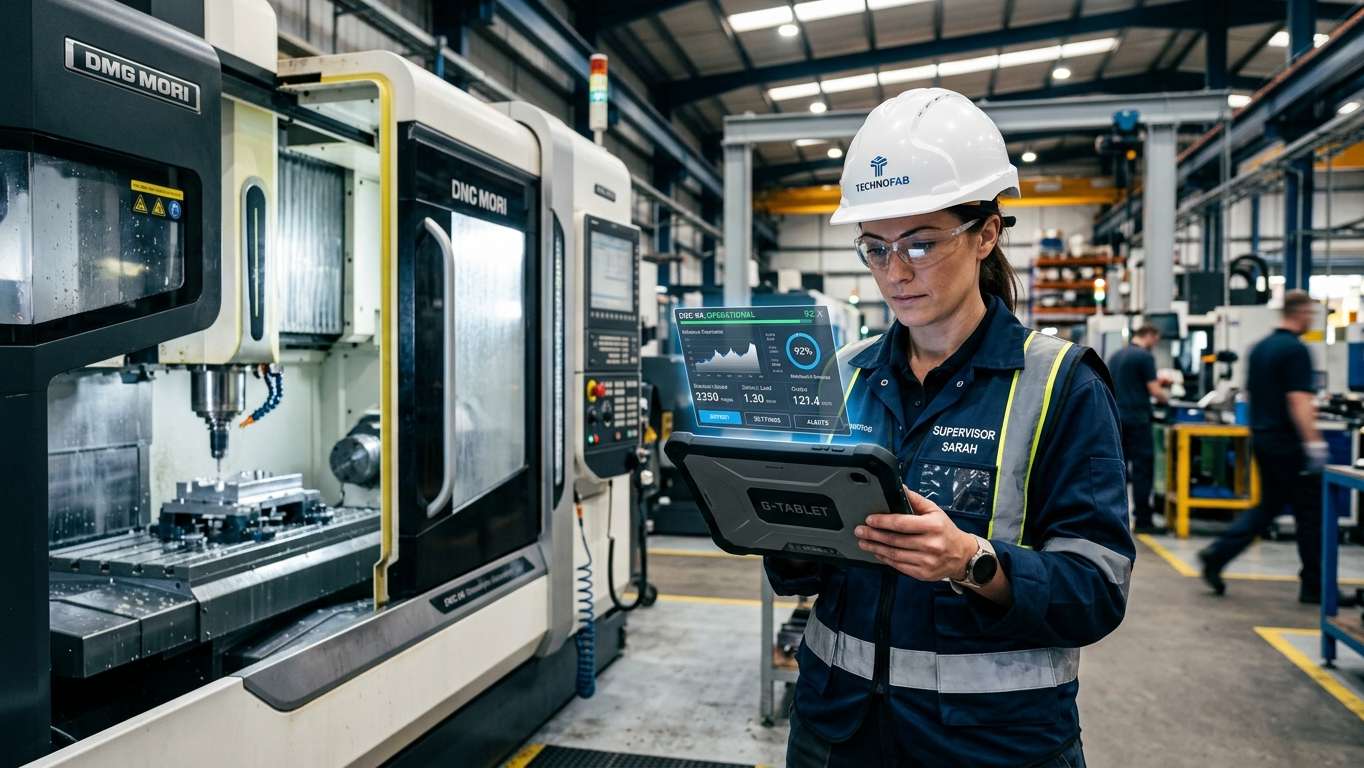
[Kịch bản mô phỏng minh họa - What-If Simulation]— CNC Precision Machining Workshop: A steel shaft order involving 6 routing operations is distributed across CNC Milling, Turning, and Heat Treatment stations. When supervisors scan the QR code on eachTraveler Card, Beas Manufacturing Terminal aggregates exact part counts at every operation step. The system automatically rolls up raw material costs plus absorbed machine and labor overheads up to the exact completed step, eliminating double-counting or omitted WIP costs. - Scenario 3
[Kịch bản mô phỏng minh họa - What-If Simulation]— Food & Pharmaceutical Plant (Strict Batch & Shelf-Life Control): During the December 31, 2026 audit, warehouse staff identify 3 flavoring batches with minor evaporation variances and 2 laminated film rolls on quality hold awaiting supplier return. Using handheld WMS scanners linked to SAP ERP, the operator scans the Batch IDs and transfers them directly to aBlocked/QC Holdwarehouse. The system immediately excludes these quarantined items from 2027ATP (Available to Promise)MRP calculations, preventing material shortages in January. - Scenario 4
[Kịch bản mô phỏng minh họa - What-If Simulation]— Garment & Footwear Export Factory (Bundle RFID Tracking): Fifteen sewing lines are producing Spring 2027 export orders with tens of thousands of cut fabric bundles (fronts, collars, sleeves) in progress. With RFID tags attached to each bundle, a supervisor walks the 15 lines with a long-range RFID reader in under 30 minutes, synchronizing 100% of WIP bundle counts to the MES AI command center for accurate 2026 revenue and cost cut-off. - Scenario 5
[Kịch bản mô phỏng minh họa - What-If Simulation]— Automated Direct Labor Cost Allocation (Account 622): Closing the books on December 31 also requires reconciling direct operator hours against every production order. Through native integration between InfoAsia HR & Payroll Software and shop-floor MES AI job-clocking terminals, actual labor hours per work order are locked simultaneously with the inventory count, ensuring complete alignment across Warehouse, Shop Floor, Finance, and HR.
5. Frequently Asked Questions (FAQs) on Year-End Inventory & WIP Valuation
Q1: If our factory operates 24/7 across 3 shifts on December 31, 2026, how can we perform a year-end inventory audit without stopping the machines?
Answer: With InfoAsia’s SAP ERP and MES AI platform, factories use a “Point-in-Time Inventory & WIP Snapshot” at exactly 24:00 on December 31, 2026. All output and material consumption before midnight are automatically logged via IoT sensors and MES terminals into fiscal year 2026, while transactions from 00:01 on January 1, 2027, are seamlessly routed to the 2027 accounting period.
Q2: How are physical-to-book inventory variances accounted for once the PDA blind count is finished?
Answer: Immediately after PDA scanning, SAP ERP generates an Inventory Counting Variance Report. Once verified and approved by management in the workflow, the system automatically posts the corresponding Inventory Adjustment journal entries in strict compliance with Vietnamese Accounting Standards (Circular 200/2014/TT-BTC) with a complete digital audit trail.
Q3: How does the system value semi-finished goods (WIP) sitting at Operation #3 out of 6 routing steps?
Answer: InfoAsia MES / Beas Manufacturing links Bill of Materials (BOM) components directly to specific Routing operations. When a batch completes Operation #3, the system automatically accumulates the exact materials issued for Operations 1–3 plus the actual machine and labor hours logged at those three work centers, delivering exact Account 154 WIP valuation.
Q4: How long does it take to deploy QR/RFID warehouse scanning and MES WIP tracking for a factory?
Answer: Depending on factory scale and warehouse complexity, item master standardization, Bin Location mapping, and QR/RFID mobile integration with SAP ERP & MES typically take 6 to 12 weeks. InfoAsia’s solution architects conduct on-site shop-floor assessments to design the optimal labeling workflow for your industry.
Q5: Can our management and accounting teams request a 1-on-1 live demo of QR inventory counting and automated WIP costing?
Answer: Yes. Factory directors, CFOs, and plant managers can book a complimentary 1-on-1 live demonstration via our SAP ERP Solutions or SAP MES & Industrial IoT pages to experience real-time barcode/RFID counting and automated WIP valuation tailored to your manufacturing sector.
🔗 Explore InfoAsia Smart Factory & Enterprise Solutions (SAP Gold Partner Ecosystem):
- MES Software (Manufacturing Execution System) — Real-Time Shop Floor Control & OEE
- SAP Business One & SAP MES Integration for Smart Factories
- APS (Advanced Planning & Scheduling) — Automated Production Optimization
- Smart Warehouse Management (WMS / Barcode / RFID Traceability)
- Contact InfoAsia Experts for a Free 1-on-1 Live System Demo

InfoAsia Việt Nam trở thành nhà cung cấp dịch vụ phần mềm số hóa nhà máy sản xuất cho thương hiệu giày hàng đầu thế giới NEW BALANCE
Công ty TNHH Mây Tre Hà Linh
SAP ERP MES and IOT Project for FVIV Factor
Buwon Industry Co, Ltd
KANGLONGDA VIETNAM PROTECTION TECHNOLOGY COMPANY LIMITED
Shini Group
TA TING PLASTIC (HAI DUONG ) CO., LTD
CÔNG TY TNHH MTV BIÊN HOA SCM