




Executive Summary: In the modern smart manufacturing era of 2026 – 2027, generic “one-size-fits-all” ERP systems have become obsolete. A software system designed for precision CNC machine shops cannot accommodate the complex regulatory formulation needs of pharmaceutical facilities or the rapid scheduling dynamics of plastics injection molding. This comprehensive strategic guide examines industry-specific manufacturing execution systems (MES) and enterprise resource planning (ERP) powered by Industrial IoT (IIoT), ERP AI, and MES AI. Discover how applying AI in manufacturing empowers 5 core industrial verticals to eliminate waste, cut downtime and excess buffer inventory costs by 25% – 35%, and improve Overall Equipment Effectiveness (OEE) by 8% to 15% towards the 75% – 80% industrial benchmark.
Empirical evidence across discrete and process manufacturing plants in Vietnam indicates that over 60% of shopfloor digitization projects struggle not from inferior software architecture, but from fundamental domain-specific operational misalignment. Precision engineering demands micro-level tracking of cutting tool degradation and multi-axis machine vibrations; technical injection molding requires monitoring mold shot cycles and injection barrel pressures; high-speed electronics assembly demands component-level reel traceability to prevent placement errors; while pharmaceutical and food processing companies depend critically on First-Expired, First-Out (FEFO) controls and electronic batch record (EBR) genealogy.
To overcome these specialized operational hurdles, the converged integration of shopfloor MES, intelligent ERP AI, and real-time Industrial IoT telemetry has become the prerequisite operational architecture for global industrial competitiveness.
1. The Three-Tier Architecture: Edge IIoT – MES AI – ERP AI
To understand how shopfloor machine states translate into financial balance-sheet gains, executives must evaluate the unified ISA-95 architectural hierarchy:
| ISA-95 Architectural Layer | Core Technology & Operational Purpose | AI & IoT Transformative Role |
|---|---|---|
| Levels 1 & 2: Shopfloor Assets & Edge IIoT | Gathers machine stroke pulses, spindle load currents, vibration acoustics, and hydraulic pressures via OPC UA, MQTT, and Modbus TCP. | Edge IoT Gateways continuously extract objective, real-time machine telemetry, eliminating dependency on retrospective manual operator log sheets. |
| Level 3: Production Operations (MES & MES AI) | Manages granular dispatching, shopfloor telemetry capture, in-line quality assurance (QA/QC), and tooling maintenance. | MES AI computes real-time OEE down to the second, conducts visual anomaly defect classification, and triggers automatic machine interlocks. |
| Level 4: Business Management (ERP & ERP AI) | Governs Material Requirements Planning (MRP), procurement, sales order fulfillment, and actual job costing calculations. | ERP AI forecasts demand variations, balances working capital inventory, and executes finite capacity multi-plant scheduling. |

2. Tailored AI and IoT Applications Across 5 Key Industrial Verticals
2.1. Precision CNC Machining & Mold Manufacturing
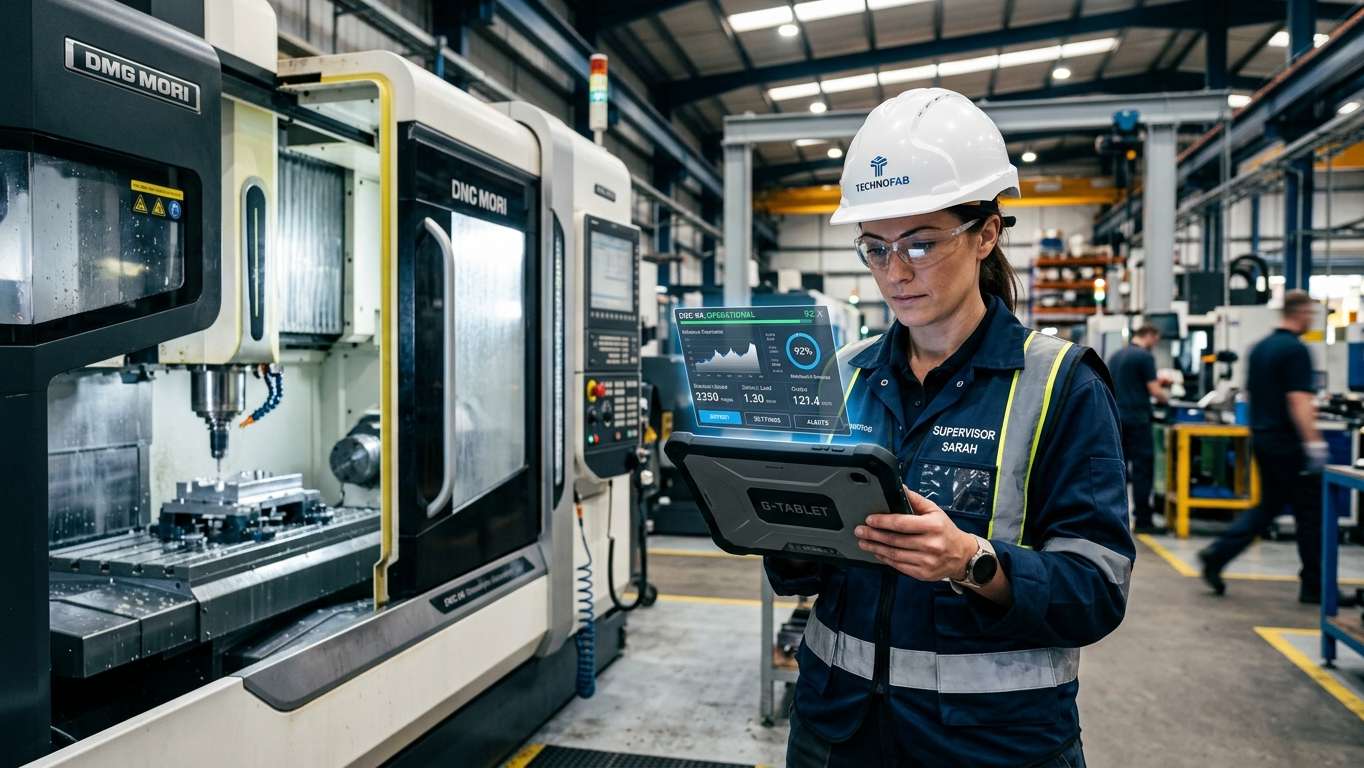
Precision machining is characterized by tight dimensional tolerances measured in micrometers ($mu m$) and multi-stage routings spanning rough milling, vacuum heat treatment, wire EDM, precision grinding, and surface coating.
- Operational Pain Point: Cutting tool wear (end mills, inserts) accounts for 15% – 20% of variable tooling budgets; catastrophic tool breakage destroys expensive pre-machined tool steel billets (SKD11, SKD61, Titanium alloys).
- IoT & MES AI Solution: High-frequency vibration sensors and spindle current transducers capture telemetry at the CNC tool holder. MES AI evaluates acoustic load harmonics, flagging severe tool wear 30 minutes in advance and firing an instantaneous emergency feed hold if fracture spikes are detected.
- ERP AI Impact: The manufacturing ERP software automatically accrues real-world machine spindle runtime against active work orders, enabling true job costing down to individual workpieces and safeguarding quoting profit margins.
2.2. Technical Plastics Injection Molding & Die Casting
Automotive and industrial plastics facilities operate continuous 3-shift schedules across dozens of hydraulic and electric servo-driven injection presses.
- Operational Pain Point: Lack of real-time visibility into cumulative mold shot counts; fluctuating melt barrel temperatures causing warpage, sink marks, or short shots.
- IoT & MES AI Solution: Edge IoT devices interface with mechanical mold clamping sensors and barrel thermal controllers. MES AI tracks cycle times per shot, instantly detecting anomalous delays exceeding 2 seconds and alerting shift supervisors.
- ERP AI Impact: The ERP AI engine maintains dynamic mold shot accumulators. Upon reaching 100,000 continuous cycles, the system locks production dispatch and schedules preventive maintenance, eliminating catastrophic mold cavitation failures that could idle assembly lines for weeks.
2.3. Electronics Assembly & High-Speed SMT Manufacturing
Surface Mount Technology (SMT) lines operate at blistering placement speeds (tens of thousands of components per hour) managing complex bills of materials (BOMs) containing thousands of discrete capacitors, resistors, and advanced microprocessors.
- Operational Pain Point: High risk of operator feeder loading errors causing entire reel placement scrap; moisture-sensitive devices (MSD) exceeding allowable ambient floor life leading to micro-cracking during reflow soldering.
- IoT & MES AI Solution: The manufacturing MES interfaces via IPC-CFX and SECS-GEM standards directly with SMT pick-and-place equipment. MES AI couples with 2D barcode scanners for robust Poka-Yoke error-proofing: if an operator scans a reel mismatched with the active CAD feeder assignment, the machine hardware interlock prevents execution. Furthermore, IoT sensors monitor ambient floor-life exposure timers for sensitive IC packages.
- ERP AI Impact: ERP AI operates real-time dynamic replenishment algorithms, tracking feeder consumption rates to trigger automated guided vehicle (AGV) dispatches from smart storage towers directly to the line prior to component starvation.
2.4. Textiles, Dyeing & Industrial Packaging
Textile and flexible packaging manufacturers contend with severe seasonal delivery pressures, complex multi-station line balancing, and volatile raw material yield rates.
- Operational Pain Point: Severe line bottlenecks along sewing and assembly conveyors; batch-to-batch color deviations ($Delta E$) causing high rejection rates; uncontrolled fabric yield loss from sub-optimal manual cutting markers.
- IoT & MES AI Solution: Industrial RFID portals and workstation touch terminals track bundle piece flow. MES AI evaluates takt times in real time, pinpointing line balance constraints and recommending immediate operator cross-station reassignments.
- ERP AI Impact: Deep learning ERP algorithms standardize chemical dye bath formulations based on ambient water chemistry and yarn lots, keeping color variation beneath visual detection thresholds. Concurrently, ERP AI optimizes raw material allocation, driving 3% to 5% reductions in fabric scrap worth substantial annual savings.
2.5. Food & Beverage, Nutraceuticals & Pharmaceuticals
Process manufacturers operating in consumable health and nutritional goods must maintain strict adherence to international regulatory standards, including cGMP, HACCP, ISO 22000, and FDA 21 CFR Part 11.
- Operational Pain Point: Expired ingredients inadvertently dispensed into mixing tanks; cold-chain temperature excursions spoiling perishable active cultures; days spent manually cross-referencing paper logs during batch audits.
- IoT & MES AI Solution: Environmental IoT sensors continuously monitor temperature, humidity, and tank flow rates. MES AI enforces strict gravimetric recipe verification: if dispensing scales detect an active ingredient deviation exceeding 0.1% of the master recipe, dosing valves shut automatically.
- ERP AI Impact: ERP AI enforces rigorous First-Expired, First-Out (FEFO) inventory rules. During regulatory audits or mock recalls, the system synthesizes full bi-directional Electronic Batch Records (EBR) linking finished goods back to raw ingredient lots and distribution channels in under 30 seconds.
3. Cross-Industry Technology Comparison Matrix
This comprehensive comparison delineates how IoT, MES AI, and ERP AI integrate across industrial manufacturing sectors:
| Manufacturing Vertical | Shopfloor IoT Telemetry | MES AI Edge Applications | ERP AI Enterprise Value |
|---|---|---|---|
| Precision CNC & Tooling | Spindle current load sensors, multi-axis bearing vibration sensors. | Predictive tool wear forecasting, real-time OEE, tool fracture feed holds. | Precise actual job costing based on spindle runtime hours and alloy scrap. |
| Plastics Injection Molding | Mold clamp stroke counters, barrel zone thermal controllers. | Cycle time anomaly detection, automated OK/NG shot counting. | Preventive mold maintenance automation driven by cumulative shot counters. |
| SMT Electronics Assembly | IPC-CFX protocols, smart dry cabinet ambient humidity sensors. | Poka-Yoke feeder error interlocks, automated optical inspection (AOI). | Multi-level BOM synchronization, predictive AGV line replenishment. |
| Textiles & Packaging | RFID WIP bundle tracking, inline optical colorimetric sensors. | Dynamic sewing line balancing according to live operator takt time. | Dye formula recipe standardization, cutting scrap minimization. |
| Pharma & Food Processing | Cold storage thermal monitors, mixing tank flow and pressure sensors. | Gravimetric recipe interlocks, continuous environmental logging. | Strict FEFO automated dispatch, complete Electronic Batch Records (EBR) < 30s. |

4. A Structured 4-Phase Roadmap for AI & IoT Adoption in Manufacturing
To maximize return on investment while mitigating operational disruptions, InfoAsia advocates a proven phased deployment roadmap:
- Phase 1 – Infrastructure Audit & Master Data Governance: Catalog existing machinery, map target PLC communication protocols, and standardize engineering bills of materials (BOMs), routings, and defect classifications.
- Phase 2 – Edge IoT Sensor Deployment: Install non-intrusive current transducers and industrial gateways to automate raw machine data capture, eliminating error-prone manual paper clipboards.
- Phase 3 – Shopfloor MES AI Activation: Deploy live OEE tracking dashboards, dynamic dispatching engines, and AI vision quality checkpoints directly at machine cells.
- Phase 4 – Enterprise ERP AI Closed-Loop Integration: Bridge operational floor telemetry with enterprise ERP ledgers, automating real-time material backflushing, dynamic inventory replenishment, and executive KPI analytics.
5. Frequently Asked Questions (FAQ)
Q1: Can older legacy machines lacking digital network cards be connected to the IoT and MES network?
Answer: Yes. InfoAsia deploys a hybrid integration methodology. Modern CNCs and PLCs connect via native Ethernet protocols (OPC UA, Fanuc FOCAS, Siemens S7). For legacy mechanical presses and lathes, non-invasive external IoT sensors (split-core current transducers, optical part counters) connect to industrial edge gateways, digitizing existing brownfield plant assets without expensive equipment replacements.
Q2: Is the capital expenditure of MES AI and ERP AI feasible for small-to-medium manufacturing enterprises (SMEs)?
Answer: Absolutely. Modular architecture permits phased rollouts: manufacturers can initiate deployments with edge IoT OEE monitoring on critical bottleneck machines, expanding into automated scheduling and full ERP AI integration once initial operational savings fund subsequent phases.
Q3: Does applying AI in manufacturing require companies to recruit specialized data scientists?
Answer: No. All proprietary genetic algorithms, predictive maintenance models, and machine vision frameworks are pre-engineered into intuitive industrial web applications. Floor supervisors and planning engineers operate the system through browser interfaces and rugged tablets without requiring coding or data science expertise.




Outstanding breakdown of the ISA-95 three-tier architecture. In plastics injection molding, mold shot counting linked directly to automated preventive maintenance ticketing in ERP is a game-changer. How do you prevent mold shot falsification on the floor?
Hello Julian! To prevent falsification or mechanical sensor tampering, InfoAsia utilizes dual-validation telemetry: an edge IoT clamp-stroke inductive sensor cross-referenced in real-time with motor hydraulic pressure curves and cycle power consumption. A shot is only registered by MES AI when both mechanical closure and thermal/pressure cycles correlate mathematically.