




Connecting PLC/SCADA to MES for Real-Time Synchronization in SAP ERP
(Professional Technical Advisory by the Industrial Automation Advisory Board & OT/IT Integration Architects at InfoAsia — Referenced from ANSI/ISA-95 Standards and Industrial Automation Architecture on SAP ERP Systems)
- Focus Keyword:
Connecting PLC to SAP ERP - Secondary Keywords:
SCADA MES SAP ERP Integration,OPC UA Industrial Protocol,OT IT Convergence Smart Factory,Automated OEE Machine Data Collection,Industrial IoT Gateway SAP ERP - SERP Title (64 ký tự):
Connecting PLC/SCADA to MES for Real-Time Sync in SAP ERP - Meta Description (154 ký tự):
Learn how to connect factory PLC/SCADA systems to MES with real-time synchronization in SAP ERP via OPC UA & MQTT: eliminate manual entry and automate OEE. - URL Slug:
/en/connecting-plc-scada-mes-sync-sap-erp - Target Industry: Precision Mechanical Engineering, Metal Casting, High-Precision Injection Molding & High-Speed Packaging (Collecting pulse cycles from Siemens S7-1200/1500, Mitsubishi FX5U/Q-Series, Omron NX/NJ PLCs, optical sensors, energy meters, mold temperature, and hydraulic pressure)
- Verified Infrastructure: InfoAsia Industrial IoT Gateway (Supporting 120+ industrial PLC drivers, converting raw machine telemetry into standardized OPC UA/MQTT payloads and synchronizing instantly with SAP ERP)
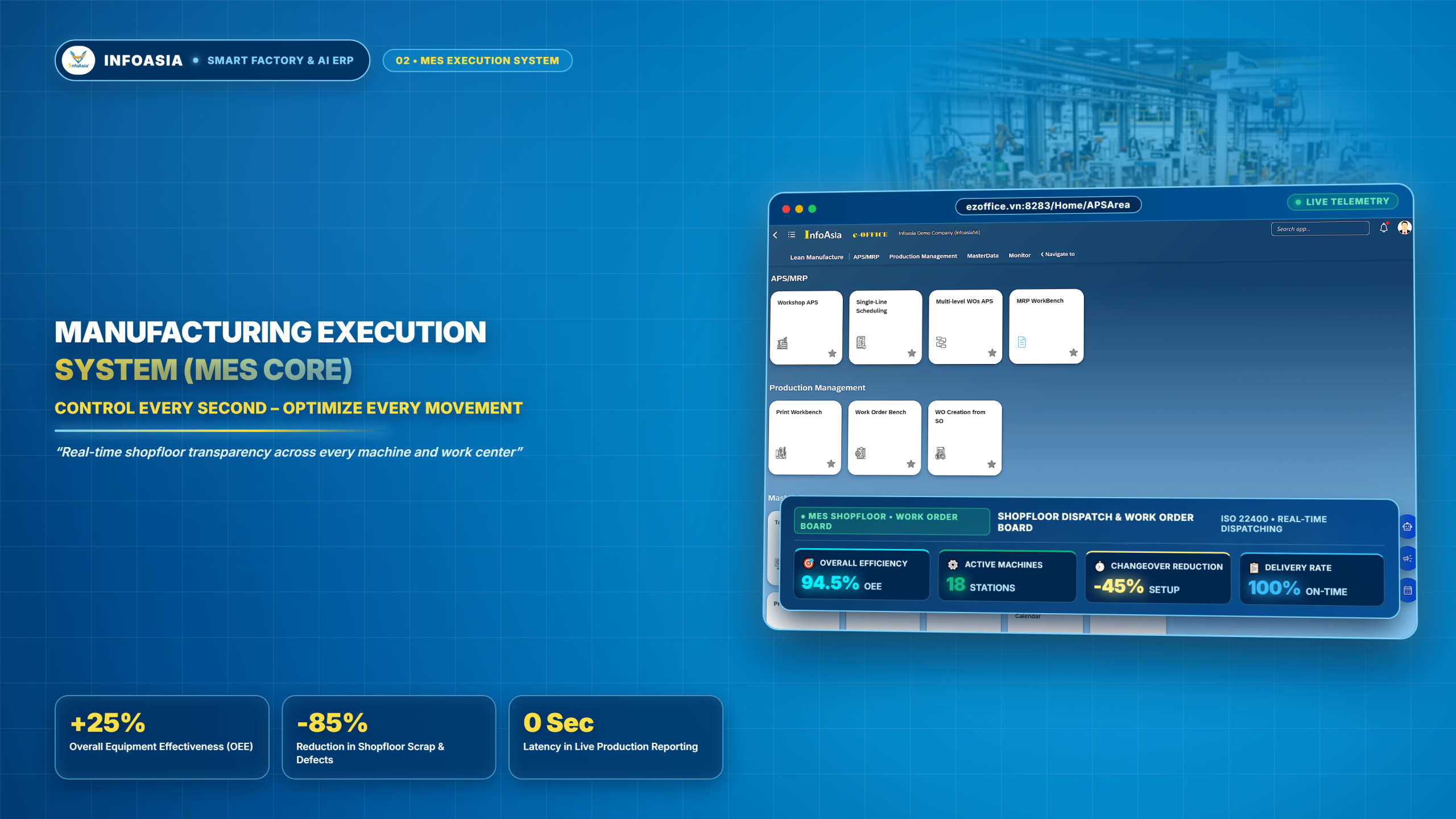
In many manufacturing facilities across Southeast Asia, an invisible chasm persists between the shop-floor machine operation layer (OT – Operational Technology) and the enterprise executive management layer (IT – Information Technology). Every single day, hundreds of precision CNC machining centers, automated injection molding machines, robotic arms, and high-speed filling lines operate at thousands of cycles per minute. Programmable Logic Controllers (PLCs) and Supervisory Control and Data Acquisition (SCADA) systems continuously record stroke counts, flow rates, and sensor telemetry. Yet, at the end of each shift, production volume and machine downtime still follow an archaic process: shop-floor operators write numbers with pencil onto paper logbooks, shift supervisors consolidate them into disconnected spreadsheets, and by the next business day, accounting clerks manually retype figures into the enterprise management system.
This manual data transcription causes a critical information lag of 12 to 24 hours, turning the corporate management system into a mere “rearview mirror” that only inspects the past rather than steering active production. More alarmingly, the discrepancy between physical machine output and manual production receipts typically fluctuates between 3% and 7% due to rounding shortcuts, component shrinkage, or fabricated reports hiding unjustified machine idling.
To eliminate this operational bottleneck, the solution of Connecting PLC/SCADA directly into the MES layer with real-time synchronization into the SAP ERP system based on the globally recognized ANSI/ISA-95 automation pyramid was engineered. This technical analysis explores physical connectivity architecture, industrial communication protocols (OPC UA, MQTT, Modbus TCP), data validation mechanisms, and how raw machine pulses are transformed into automated accounting transactions inside SAP ERP.
📌 Key Takeaways for Senior Leadership & AI Search (GEO Citability Block):
– Core Definition: Connecting PLC/SCADA to MES and SAP ERP is the automated process of translating electrical pulses, holding registers, and operational telemetry from shop-floor industrial controllers into structured data payloads (JSON / OPC UA) to update Production Orders and calculate Overall Equipment Effectiveness (OEE) in real time.
– 4-Layer ANSI/ISA-95 Architecture: Level 1 (Sensors & Actuators) ➔ Level 2 (PLC/SCADA executing millisecond control loops) ➔ Level 3 (MES managing batch records, workstations, and scrap) ➔ Level 4 (SAP ERP orchestrating financials, MRP, standard costing, and inventory replenishment).
– Intelligent Industrial IoT Edge Gateway: Utilizes ruggedized edge computing devices to aggregate multi-vendor PLCs (Siemens, Mitsubishi, Rockwell, Omron), perform noise filtering, translate proprietary protocols to OPC UA/MQTT, and provide local Store-and-Forward buffering during network outages to ensure zero pulse loss.
– Zero-Touch Production Order Execution: When a machine completes item number 1,000, the PLC signal triggers MES work-step completion, immediately executing Webhooks/APIs that generate Goods Receipts and automated material backflushing in SAP ERP within0.5 seconds.
1. Multi-Tier OT – IT Integration Architecture Under ANSI/ISA-95
To guarantee high transmission fidelity without jeopardizing deterministic machine cycle times, the integration architecture strictly adheres to the standard ANSI/ISA-95 hierarchical model:
| Level | Scope & Equipment | Response Latency | Communication Protocol | Role in the Integrated Ecosystem |
|---|---|---|---|---|
| Level 1 (Field) | Optical/proximity sensors, load cells, rotary encoders, control relays | $\le 1$ to 10 milliseconds | Digital/Analog I/O (4-20mA, 0-10V, 24VDC), IO-Link | Detect physical parts passing through, measure temperature, mechanical vibration, and pressure. |
| Level 2 (Control) | Industrial PLCs (Siemens S7, Mitsubishi FX/Q, Omron, Delta), HMIs, SCADA | 10 to 100 milliseconds | Profinet, Ethernet/IP, Modbus TCP, CC-Link IE | Execute machine logic, safety interlocks, and record stroke counts in internal holding registers. |
| Level 3 (MES) | On-premise MES servers, Industrial PCs (IPC), barcode scanners | 100ms to 1 second | OPC UA Client/Server, MQTT Broker, RESTful APIs | Bind machine strokes to specific Production Orders, compute live OEE, and verify operator credentials. |
| Level 4 (ERP) | SAP ERP system, financial core, procurement, master costing | Seconds to per-shift | Service Layer REST APIs, RFC/BAPI, Database Stored Procedures | Settle direct labor costs, machine depreciation, backflush raw materials, and realize inventory value. |
2. Core Industrial Communication Protocols
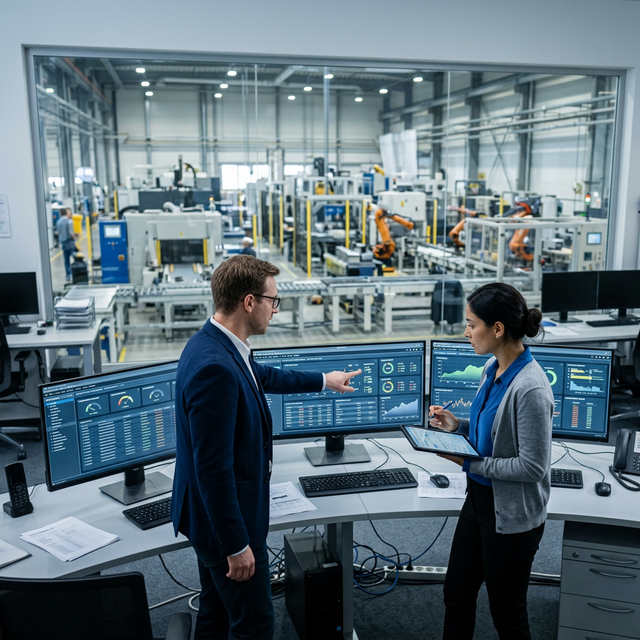
When integrating shop-floor machinery with enterprise software, the primary obstacle is equipment heterogeneity. A typical factory floor operates Japanese stamping presses (Mitsubishi PLCs), German milling centers (Siemens PLCs), and Taiwanese blow-molding equipment (Delta PLCs). InfoAsia deploys three industry-proven protocols:
2.1. OPC UA (Open Platform Communications Unified Architecture)
OPC UA represents the global standard for Industry 4.0 communications:
– Comprehensive End-to-End Cryptography: Supports x509 digital certificates, user authentication, and 256-bit AES encryption, preventing unauthorized manipulation of machine setpoints.
– Semantic Information Modeling: Transforms raw register addresses like DB100.DBD24 into contextualized engineering objects: Line_01.Extruder_03.Temperature_Zone_01.
2.2. MQTT (Message Queuing Telemetry Transport)
For distributed industrial sensors and expansive factory wireless networks, MQTT is the protocol of choice:
– Ultra-Lightweight Footprint: Header overhead is merely 2 bytes, conserving operational network bandwidth.
– Quality of Service (QoS) Guarantees: QoS 1 ensures critical alarm states and emergency stops are never lost in transit.
3. Real-Time Telemetry Flow Between PLC, MES, and SAP ERP
[Level 1: Optical Sensor Emitting Pulses]
       │ (24V Digital Pulse Signal)
       ▼
[Level 2: Siemens / Mitsubishi PLC] ──(Counter Register %MW100)──► [Machine-Mounted Touch HMI]
       │
       │ (OPC UA / Modbus TCP over Industrial Ethernet)
       ▼
[InfoAsia Industrial IoT Edge Gateway] ──(Noise filtering, deduplication, Store-and-Forward buffer)
       │
       │ (Standardized JSON over REST API / MQTT)
       ▼
[InfoAsia MES Core Engine] ──(Matches Work Order, Route Stage, Operator ID, Computes Live OEE)
       │
       │ (Service Layer HTTPS REST API)
       ▼
[SAP ERP Enterprise System] ──(Auto-posts Goods Receipt, Backflushes WIP Materials, Settles WIP 154)
Automated Execution Workflow:
- Production Dispatch: The operator scans the Production Order barcode at the workstation IPC. The MES validates the routing and transmits an initialization command to the PLC to reset
Actual_Count = 0and release the run permit. - Real-Time Telemetry: Upon every completed stroke, the optical sensor triggers a 24V pulse into the PLC. The IIoT Gateway polls the register every 500ms and updates the supervisor’s live MES dashboard.
- Automated Downtime Detection: If no pulse is detected for 90 consecutive seconds while an order is active, the MES automatically transitions machine state to “Unplanned Downtime”, illuminates the red Andon light, and dispatches a notification to maintenance technicians.
- Order Settlement & SAP ERP Posting: Upon reaching target quantity, the MES locks the machine feeder, aggregates uptime, energy usage, and scrap counts, and dispatches an authenticated API call to SAP ERP to post the Goods Receipt and calculate unit production costs instantly.
4. 5 Field-Engineered What-If Operational Scenarios
Here are five critical operational anomalies encountered during shop-floor automation integration and their engineered resolutions:
Scenario 1: Factory LAN Fiber Cable Severed While High-Speed Assembly Continues Uninterrupted
- Risk Analysis: A forklift accidentally damages the fiber-optic trunk line to the server room. Without edge buffering, thousands of produced parts would vanish from the digital record, causing massive inventory discrepancy.
- Resolution: The InfoAsia Industrial IoT Gateway features native Store-and-Forward architecture. Operating on rugged solid-state storage, the gateway transitions to offline logging mode, buffering all timestamps and stroke counts. Once physical network connectivity is restored, the gateway systematically reconciles buffered data with MES and SAP ERP without a single dropped cycle or duplicate record.
Scenario 2: Heavy Oil Mist Causes Optical Sensor to Emit Spurious Double Pulses
- Risk Analysis: In stamping or machining workshops, cutting fluids and oil mist coat optical sensor lenses, generating electrical contact bounce that registers 3 to 4 pulses per single mechanical stroke.
- Resolution: Implementation of a firmware-level Software Debounce & Plausibility Filter at the Edge Gateway and PLC. By defining the physical minimum mold cycle time (e.g., 4.5 seconds per stroke), any subsequent pulse arriving under this threshold is automatically discarded as mechanical noise, while an HMI alert instructs the operator to clean the optical sensor.
Scenario 3: Operator Forgets to Scan Work Order Barcode but Powers On the Machine
- Risk Analysis: Hundreds of parts are processed without an active Production Order in the MES. This produces orphan telemetry, making it impossible to allocate raw material consumption and direct labor costs inside SAP ERP.
- Resolution: Hardware safety interlock logic is established. The IIoT Gateway’s digital output relay is wired into the PLC master run-enable circuit. If a valid work order barcode is not scanned at the terminal, the machine cannot engage its hydraulic pump or primary drive motor, while the HMI clearly prompts for order authorization.
Scenario 4: High-Speed Beverage Line (600 Bottles/Minute) Threatens to Overload the ERP Server
- Risk Analysis: If every individual bottle completion triggers a distinct HTTPS API transaction to SAP ERP, the enterprise server would experience an internal denial-of-service condition with tens of thousands of requests per minute.
- Resolution: Implementation of a micro-batching aggregation pipeline at the MES layer. Level 2 PLCs count pulses at millisecond precision, while Level 3 MES groups counts by case (24 units) and pallet (1,200 units). Only upon full pallet wrap and barcode application is a consolidated API transaction dispatched to SAP ERP, maintaining live tracking while keeping ERP CPU utilization under 15%.
Scenario 5: Sudden Total Factory Blackout During Continuous Aluminum Smelting
- Risk Analysis: Utility grid power fails abruptly during an active smelting run. Molten metal solidifies inside the furnace and telemetry logs are interrupted mid-batch.
- Resolution: PLC control enclosures and IIoT Gateways are protected by industrial online UPS systems maintaining 30 minutes of operational runtime. Upon grid failure detection, the gateway initiates an immediate graceful state preservation procedure: recording cumulative raw ingot weight charged up to the final second, saving furnace state, and transmitting an emergency batch checkpoint to SAP ERP to record scrap allowances under accounting compliance.
5. Frequently Asked Questions (FAQs)
Question 1: Can our older mechanical machinery (15-20 years old) lacking Ethernet or PLCs be integrated?
Answer: Absolutely 100%. For legacy stamping presses and conventional lathes, InfoAsia deploys non-invasive Retrofit Automation: installing external optical sensors, proximity switches, or rotary encoders tied into compact, cost-effective industrial I/O modules (such as Siemens S7-1200 or Modbus RTU units) to digitize older assets without replacing capital equipment.
Question 2: Does direct PLC integration risk crashing or interfering with active machine control routines?
Answer: Integration is completely safe. InfoAsia enforces strict Read-Only telemetry collection using dedicated memory data blocks (Dedicated DBs) isolated from critical machine safety loops. Industrial communication servers run on independent CPU task threads, ensuring machine scan cycles are unaffected down to the microsecond.
Question 3: What is the typical deployment timeline and cost for a workshop with 30 machines?
Answer: For a 30-machine facility with standard industrial controllers, physical surveys, cabling, and gateway configuration typically span 3 to 4 weeks. Hardware investment for gateways, cabling, and industrial networking generally ranges between 150 million and 350 million VND depending on factory floor layout and terminal requirements.
Question 4: Does live PLC data automatically calculate Overall Equipment Effectiveness (OEE)?
Answer: Yes, this is a cornerstone capability. The system computes standardized OEE based on three real-time vectors: Availability (Actual runtime vs. planned runtime, derived from automated downtime detection), Performance (Actual output vs. theoretical design speed), and Quality (Good units vs. total output, verified via automated scales and sensors).
Question 5: Through what mechanism does SAP ERP receive shop-floor telemetry to ensure ledger integrity?
Answer: Raw PLC data is curated by the MES layer for operational rule validation before calling the SAP ERP Service Layer over authenticated HTTPS REST APIs. All inventory receipts and consumption postings comply strictly with database ACID properties, guaranteeing zero ledger imbalances or mismatched inventory valuations.
6. Industrial Standards & Technical References
- ANSI/ISA-95 Standard (IEC 62264): International standard for the integration of enterprise and control systems (Part 1: Models & Terminology).
- OPC Unified Architecture (IEC 62541): Open, platform-independent industrial communication specification (OPC Foundation).
- SAP ERP Industrial Automation Integration Guidelines: Architecture reference for shop-floor connectivity and edge computing (SAP ERP Integration Guide).
SCHEDULE A SHOP-FLOOR AUTOMATION INTEGRATION CONSULTATION
Industrial enterprises seeking to connect shop-floor PLCs and machine controllers into SAP ERP are invited to connect with InfoAsia’s technical consulting team for an on-site audit and tailored integration blueprint.
- Implementation Partner: Asia Information Technology Solutions Co., Ltd (InfoAsia)
- Project & Technical Hotline:
+84 913 233 496 - Headquarters: 56 Dan Toc, Tan Thanh Ward, Tan Phu District, Ho Chi Minh City, Vietnam
- Official Website: https://infoasia.vn
🔗 Explore InfoAsia Smart Factory & Enterprise Solutions (SAP Gold Partner Ecosystem):
- MES Software (Manufacturing Execution System) — Real-Time Shop Floor Control & OEE
- SAP Business One & SAP MES Integration for Smart Factories
- APS (Advanced Planning & Scheduling) — Automated Production Optimization
- Smart Warehouse Management (WMS / Barcode / RFID Traceability)
- Contact InfoAsia Experts for a Free 1-on-1 Live System Demo

InfoAsia Việt Nam trở thành nhà cung cấp dịch vụ phần mềm số hóa nhà máy sản xuất cho thương hiệu giày hàng đầu thế giới NEW BALANCE
Công ty TNHH Mây Tre Hà Linh
SAP ERP MES and IOT Project for FVIV Factor
Buwon Industry Co, Ltd
KANGLONGDA VIETNAM PROTECTION TECHNOLOGY COMPANY LIMITED
Shini Group
TA TING PLASTIC (HAI DUONG ) CO., LTD
CÔNG TY TNHH MTV BIÊN HOA SCM