




Executive Summary: In modern precision discrete and batch manufacturing environments (2026 – 2027), managing shopfloor machine allocations via disconnected spreadsheets has become the primary operational bottleneck stifling enterprise throughput. This technical guide explores AI-powered dynamic production scheduling and Finite Capacity Advanced Planning and Scheduling (APS) systems. We examine how genetic algorithms enable factories to dynamically reschedule complex production floors in within 3 to 5 minutes, reducing machine changeover downtime by 35% to 45% and elevating On-Time In-Full (OTIF) fulfillment rates to 92% – 96%.
On production floors across CNC machining, plastics injection molding, packaging, and high-mix low-volume electronics manufacturing, planning departments fight an exhausting daily battle. Every morning, production planners spend 3 to 4 hours manually piecing together hundreds of work orders across dozens of machine work centers. Yet, the moment an inevitable shopfloor disturbance strikes at 10:00 AM—a primary stamping press suffers bearing failure, a critical component delivery is delayed by 24 hours, or a tier-1 customer demands expedited shipment—the entire schedule instantly collapses.
Planners must scramble to conduct emergency floor meetings, manually cross-referencing multiple spreadsheets to rebuild the sequence. During this prolonged recalculation window, multi-million-dollar machine assets sit idle, operators wait without clear work instructions, and overhead carrying costs skyrocket. This fundamental vulnerability explains why AI production scheduling has transitioned from an experimental capability into a mandatory operational asset for competitive manufacturing enterprises.
1. Foundational Flaws: Infinite Capacity Planning vs. AI Finite Capacity APS
To evaluate the quantifiable ROI of automated scheduling, operations leaders must distinguish between legacy scheduling mechanics and modern cognitive algorithms:
| Evaluation Dimension | Legacy Infinite Capacity Planning (Spreadsheets / Standard ERP) | AI-Powered Finite Capacity APS (InfoAsia Dynamic Engine) |
|---|---|---|
| Work Center Capacity Modeling | Assumes infinite machine availability, resulting in severe scheduling bottlenecks, machine overloads, and phantom capacity. | Strictly models real-world finite capacity: machine hours, preventive maintenance downtime windows, and thermal cooling periods. |
| Auxiliary Constraint Handling | Only accounts for raw machine run-times, completely ignoring tooling, molds, jigs, and operator skill constraints. | Multi-constraint mathematical modeling: Work Center + Compatible Tooling/Die + Operator Skill Matrix + Real-time Material Readiness. |
| Changeover / Setup Optimization | Uses a static, blanket average setup duration regardless of the sequencing order between consecutive work orders. | Dynamic sequence-dependent setup matrices: automatically clusters identical resin colors, tooling setups, and raw materials. |
| Shopfloor Disturbance Response | Manual recalculation requiring 4 to 8 hours of tedious planner coordination while machines sit idle. | Autonomous genetic algorithm optimization achieving factory-wide dynamic rescheduling in within 3 to 5 minutes. |
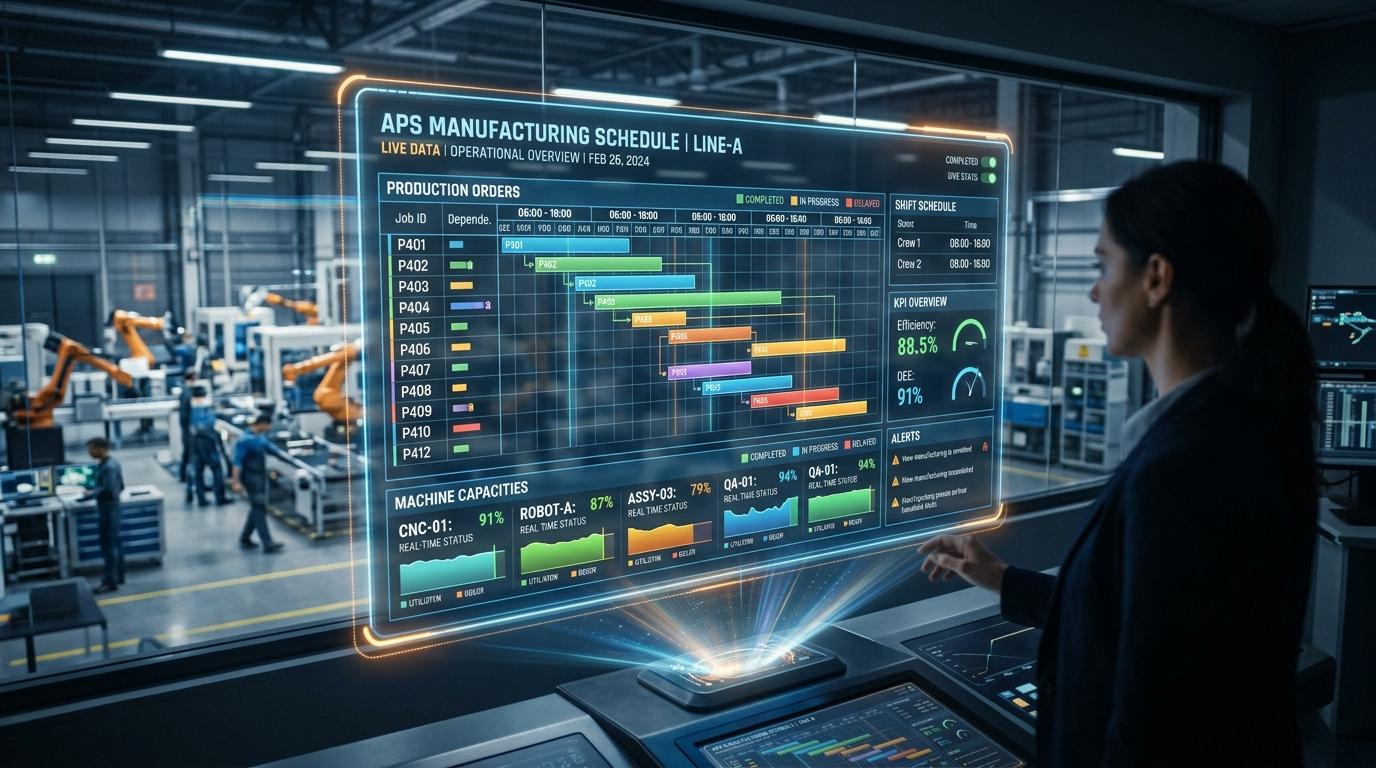
2. Algorithmic Architecture: Multi-Objective Genetic Algorithms in Dynamic APS
Sequencing $N$ production work orders across $M$ heterogeneous machine centers subject to real-world precedence constraints is a classic NP-Hard combinatorial optimization challenge. Evaluating all permutations mathematically exceeds human cognitive capacity.
2.1. Multi-Objective Genetic Algorithm (GA) Optimization
The InfoAsia AI APS engine mimics biological evolutionary principles to converge on mathematically optimal schedules within seconds:
- Population Initialization: The system automatically synthesizes thousands of candidate scheduling chromosomes adhering to technical factory constraints.
- Multi-Objective Fitness Evaluation: Candidate solutions are rigorously scored against core factory KPIs: minimizing cumulative tardiness, minimizing aggregate changeover hours, and balancing workload distributions across parallel work centers.
- Crossover & Mutation Operators: High-performing schedules undergo genetic crossover and controlled mutations, iteratively converging toward the global Pareto-optimal frontier within 3 to 5 minutes.
2.2. Closed-Loop Reinforcement Learning for Shopfloor Telemetry
Unlike static scheduling packages, the engine continually ingests real-time execution feedback via high-speed interfaces with the manufacturing execution system (MES). When an edge sensor flags an unexpected equipment fault, the AI recalculates the active state space, seamlessly diverting downstream operations to alternate qualified work centers without jeopardizing strategic delivery commitments.
3. Reducing Changeover Downtime by 35% to 45% via Sequence-Dependent Matrices
Machine setup and tooling changeover downtime represents one of the largest hidden drains on overall equipment effectiveness (OEE). In plastics injection molding, transitioning from black resin to clear/white resin requires extensive purge-and-clean cycles lasting up to 2 hours; conversely, transitioning from white to dark resin requires mere minutes.
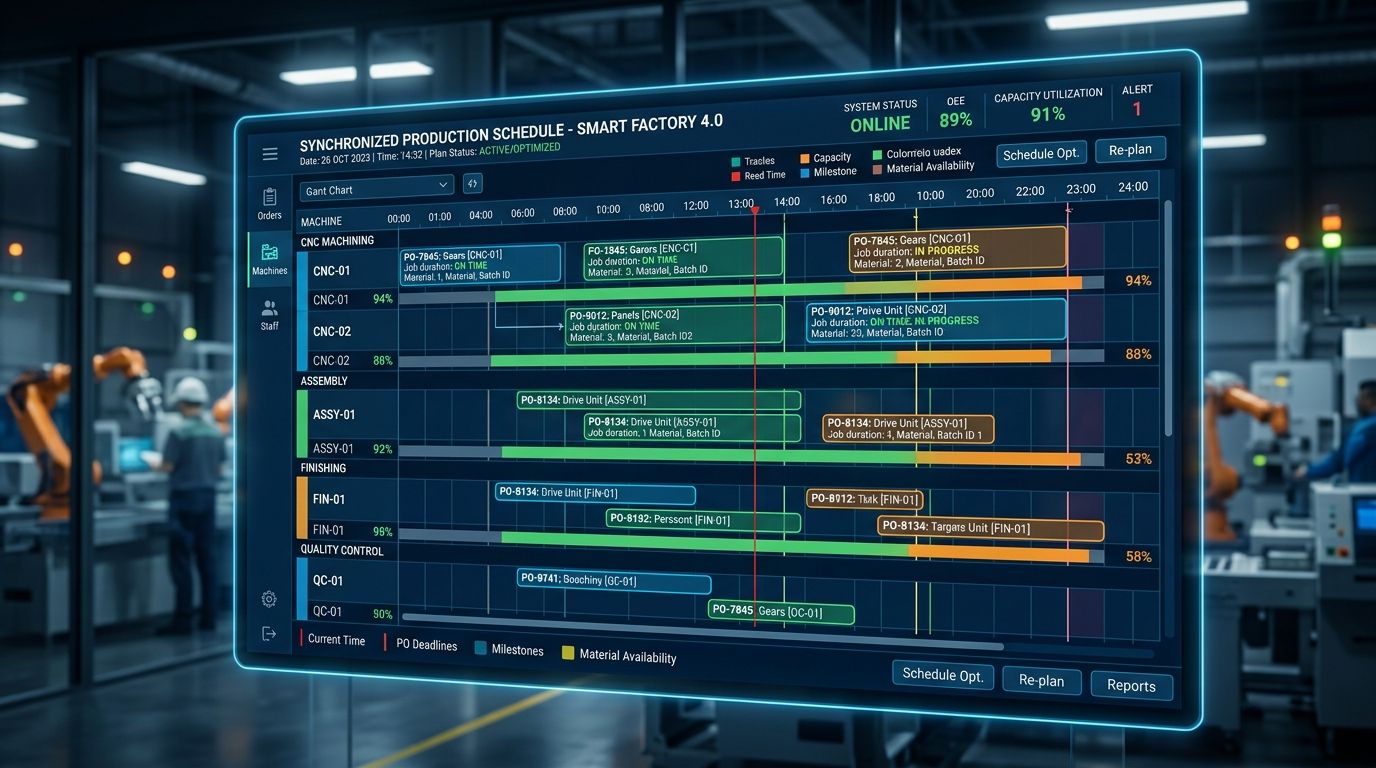
The AI APS engine eliminates this inefficiency through Sequence-Dependent Setup Optimization:
- Technology Grouping & Batching: AI clusters production orders sharing identical tooling fixtures, metallurgical alloy specs, or resin melt temperatures sequentially on the same machine.
- Intelligent Sequencing Paths: Work orders automatically progress along optimal transition curves (e.g., light colors to dark colors, narrow widths to wider dimensions), minimizing purge cycles and mechanical adjustments.
- Proven Quantifiable Results: Deployed across industrial partner facilities, intelligent sequencing reduces total setup downtime by 45% to 55%, directly recovering 15% to 20% in plant capacity without capital expenditure on new machinery.
4. Two-Way Integration: AI APS – SAP Business One – Shopfloor MES
The true operational power of AI scheduling is realized when tightly coupled with enterprise financial planning and physical factory telemetry:
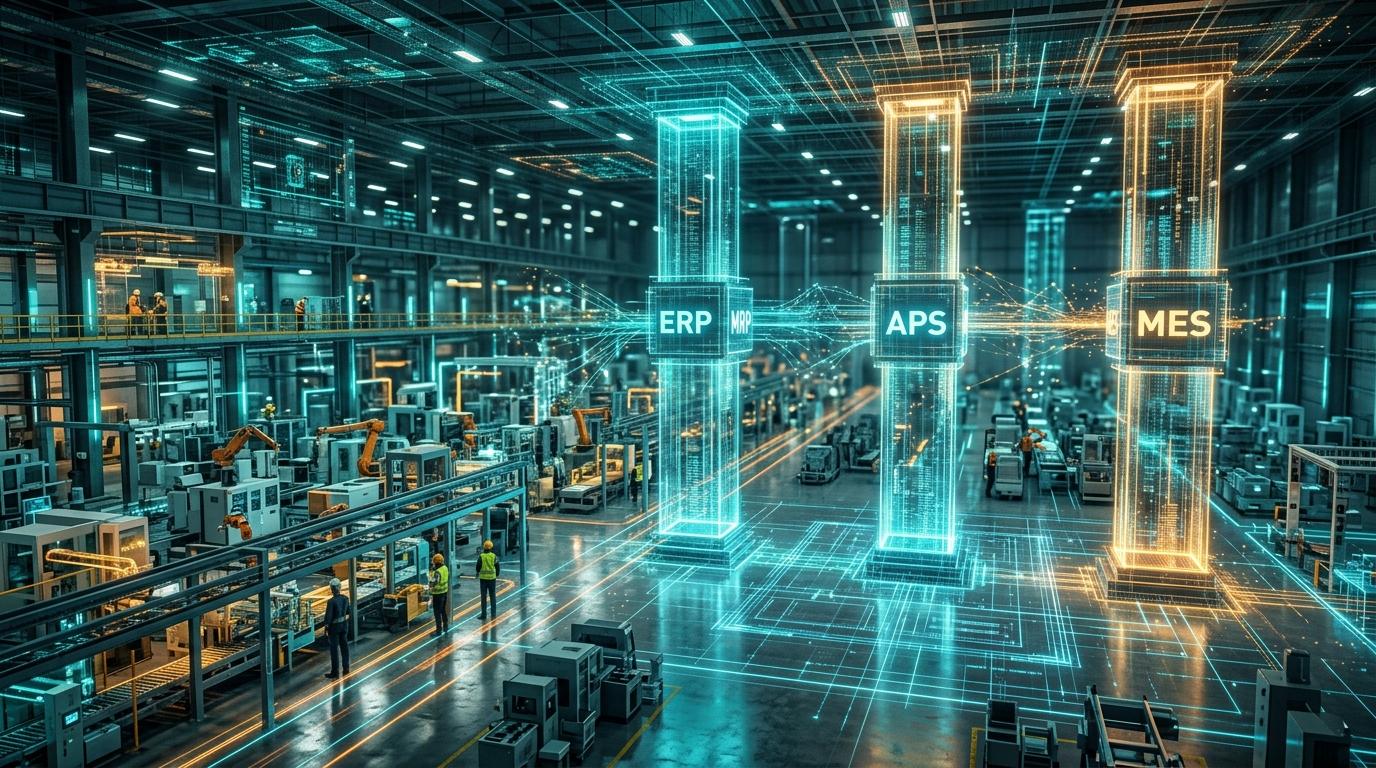
- Top-Down (ERP ➔ AI APS ➔ MES): Approved sales orders and multi-level bills of materials (BOMs) from the core manufacturing ERP system feed directly into the AI APS engine. Once optimized, electronic dispatch orders push instantly to shopfloor machine-mount terminals.
- Bottom-Up (MES ➔ AI APS ➔ ERP): Actual machine telemetry, piece counts, scrap records, and cycle times flow upstream from industrial IoT gateways. When floor conditions deviate from the benchmark plan, dynamic rescheduling triggers automatically.
- High-Speed Architecture via SAP DI-API: InfoAsia implements specialized proprietary API wrappers, isolating intensive algorithmic computations from the core financial ledger, maintaining zero latency and saving enterprises substantial software license fees.
5. Four Proven ROI Benchmarks for Manufacturing Leadership
Deploying AI-driven finite capacity scheduling yields measurable balance-sheet performance gains:
- 6% to 12% Factory-Wide OEE Uplift: Achieved by eliminating idle machine waiting times and compressing changeovers.
- On-Time In-Full (OTIF) Delivery at 92% – 96%: Eliminates late delivery penalties and protects customer relationships through realistic, constraint-aware delivery commitments.
- 30% to 40% Reduction in Overtime Labor Costs: Workload balancing smooths production peaks, eliminating weekend rush shifts while maximizing normal-shift asset utilization.
- 90% Reduction in Planning Overhead: Replaces 4 hours of daily planner spreadsheet assembly with a single-click 60-second optimization review.
6. Frequently Asked Questions (FAQ)
Q1: Can AI APS manage complex external subcontracting operations?
Answer: Yes. InfoAsia AI APS models external vendors (electroplating, heat treatment, specialized coating) as external work centers with specific transportation lead times, minimum batch sizes, and subcontractor capacity calendars.
Q2: How does the system handle floor discrepancies when machines run slower than standard cycle times?
Answer: Through continuous IoT and barcode integration, if a work center runs 10% below standard cycle time or remains paused beyond tolerance limits, the engine alerts production supervisors and recommends 3 optimal mitigation schedules.
Q3: What is the typical deployment timeframe for an AI APS module?
Answer: Standard implementation requires 2 to 4 months, encompassing master data structuring (BOMs, routings, setup matrices), algorithm calibration to plant-specific constraints, parallel validation runs, and formal go-live handoff.


The comparison between infinite capacity spreadsheets and finite capacity AI scheduling hits right at the core of our shopfloor challenge. Does the dynamic rescheduling engine support sub-contractor routing steps where secondary surface coating takes 2-3 days outside the plant?
Hello Marcus! Yes, absolutely. InfoAsia AI APS natively models external subcontractor operations as external finite capacity work centers with user-defined transit lead times, minimum transfer batch sizes, and vendor capacity calendars. The genetic algorithm respects these lead times without causing idle waiting on downstream CNC finishing cells.