




Key Takeaways:
- Critical Mid-Year Closing Milestone on Wednesday, June 30, 2027: The conclusion of the first half of 2027 (
H1/2027) is the strategic checkpoint for plant executives to audit operational performance before entering the high-volume Q3–Q4 (H2/2027) manufacturing peak. - Data-Driven OEE (Overall Equipment Effectiveness) Diagnostics: Rather than relying on rough spreadsheet averages, MES AI Software paired with industrial IoT decomposes the Six Big Losses across Availability x Performance x Quality for every production line over Q1 and Q2/2027.
- Calibrating Bill of Materials (BOM) and Routing Standards: Reconciling actual shop-floor material consumption and cycle times against baseline engineering standards in SAP ERP ensures highly accurate MRP procurement planning for the second half of 2027.
- Zero-Downtime Mid-Year Inventory & WIP Reconciliation: Lot-level QR/RFID tracking inside Production Management Software captures an exact midnight
June 30, 2027snapshot of Accounts 152, 154, and 155 in strict compliance with Circular 200/2014/TT-BTC. - Re-Leveling Finite APS Capacity for H2/2027: Eliminates bottleneck work-center constraints uncovered during the H1 review to maximize second-half throughput.
1. Why the June 30, 2027 Mid-Year Review Defines Full-Year Manufacturing Profitability
In an industrial enterprise’s annual operating cycle, Wednesday, June 30, 2027 is more than an interim accounting close—it is the most critical engineering and operational calibration milestone of the year. After six months of live production since January 2027, baseline assumptions regarding machine cycle speeds, scrap percentages, and supplier delivery lead times inevitably diverge from the original Annual Operating Plan (AOP).
If a factory enters Q3 and Q4/2027 without auditing and recalibrating its BOM (Bill of Materials) and Routing master data at the end of June, minor variances in polymer resin usage, steel coil offcuts, chemical dosing, or mold changeover durations will compound into severe Cost of Goods Sold (COGS) overruns by year-end.
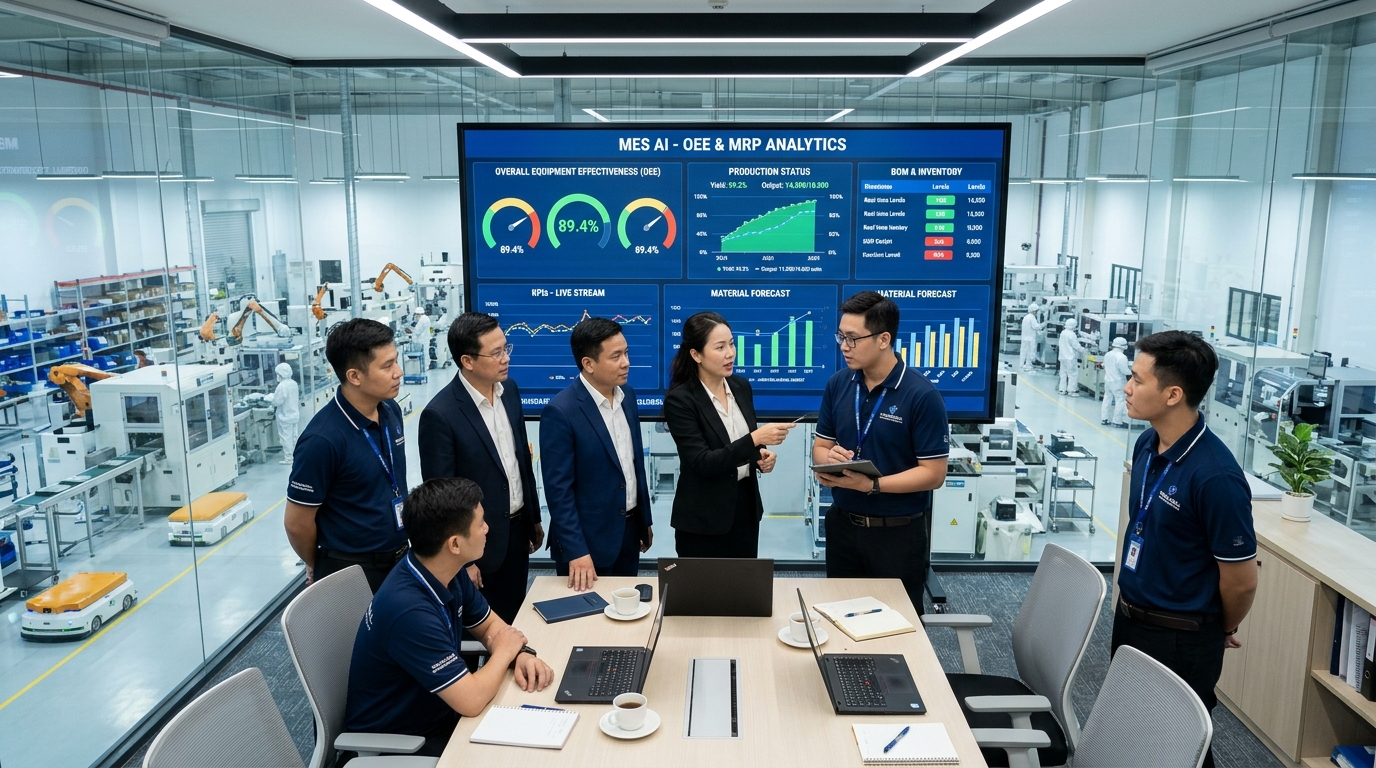
When operating on a unified SAP ERP – MES AI – APS – IoT architecture, the June 30, 2027 mid-year review transforms from subjective status meetings into a precise, data-driven optimization cycle.
2. Three Core Engineering & Financial Review Pillars for June 30, 2027
2.1. Deconstructing H1/2027 OEE Telemetry via Industrial IoT & MES AI
OEE (Overall Equipment Effectiveness) is governed by the global manufacturing formula: $$\text{OEE} = \text{Availability} \times \text{Performance} \times \text{Quality}$$ Within MES & Industrial IoT Production Management Software, every PLC stoppage signal and cycle count recorded between January and June 2027 is aggregated into Pareto loss charts—revealing whether capacity losses stemmed primarily from material starvation, prolonged mold/die changeovers, or micro-stoppages and slow cycles.
2.2. Auditing BOM Scrap Variances and Operation Routing Cycle Times
An item engineered at a standard consumption of 1.05 kg of raw material per unit in January may exhibit an actual H1 average of 1.09 kg on MES Software due to raw-material grade shifts or startup purge losses. By comparing integrated BOM & Routing Variance reports between MES AI and SAP ERP, Industrial Engineering (IE) and Cost Accounting teams gain empirical proof to update standard cost rollups for H2/2027.
2.3. Mid-Year Warehouse & Work-in-Progress (WIP) Snapshot on June 30, 2027
Powered by QR/RFID WMS barcode scanning and real-time operation reporting in InfoAsia’s Cloud ERP – MES Integration, factories execute their mid-year physical count on Wednesday afternoon (June 30, 2027) using a digital Point-in-Time Snapshot—reconciling physical floor stock 100% with General Ledger Accounts 152, 153, 154, and 155 under Circular 200/2014/TT-BTC.
3. H1/2027 Mid-Year Factory Diagnostic Matrix in SAP ERP & MES AI
| Diagnostic Metric (June 30, 2027) | Formula / Primary Data Source in MES AI & IoT | Target Benchmark | H2/2027 Optimization Action in SAP ERP & APS |
|---|---|---|---|
| Equipment Availability | $\frac{\text{Actual Run Time}}{\text{Planned Production Time}}$ | $\ge 88\% – 92\%$ | Apply SMED quick-changeover protocols; enable setup-matrix batch grouping in APS. |
| Machine Speed Performance | $\frac{\text{Ideal Cycle Time} \times \text{Total Count}}{\text{Actual Run Time}}$ | $\ge 90\% – 95\%$ | Diagnose chronic micro-stoppages via IoT vibration/current logs; schedule targeted mechanical overhauls. |
| First Pass Yield (Quality Rate) | $\frac{\text{Good Units Produced}}{\text{Total Units Produced}}$ | $\ge 98\% – 99.5\%$ | Activate real-time Statistical Process Control (SPC) limits in MES AI at high-scrap operations. |
| BOM Material Usage Variance | Delta between Actual Quantity Issued (MES) and Standard BOM Quantity (SAP ERP). | Variance within $\le \pm 1.5\%$ | Release updated BOM Revisions in SAP ERP effective July 1, 2027 for accurate H2 MRP runs. |
| Shop-Floor WIP Velocity | Average dwell time and valuation of open WIP (Account 154) lots between routing steps. | Reduce line-side WIP by $20\% – 35\%$ | Re-balance finite work-center capacities in APS to eliminate intermediate buffer congestion. |

4. Five Real-World Mid-Year Optimization Scenarios for June 30, 2027 (What-If Simulation)
- [Illustrative Simulation Scenario – What-If Simulation] Uncovering Hidden Mold Changeover Losses from H1/2027 OEE Analytics:
- Context: The June 30, 2027 mid-year MES AI review reveals that a metal stamping workshop achieved only 68% OEE in H1, with die changeover downtime consuming 22% of planned time due to unsequenced order dispatching.
- ERP AI + MES AI Resolution: Effective
July 1, 2027, planners enable Setup Matrix Optimization inside APS. Work orders sharing common master dies are automatically sequenced together, cutting changeover downtime by 40% and lifting workshop OEE to 81% in July 2027.
- [Illustrative Simulation Scenario – What-If Simulation] Recalibrating Routing Cycle Times to Sharpen Q3/2027 Export Quotations:
- Context: After upgrading to carbide cutting tooling in April 2027, actual CNC cycle time for a drive-shaft component dropped from 120 seconds to 95 seconds per piece (verified by IoT spindle telemetry), yet SAP ERP still held the legacy 120-second standard.
- ERP AI + MES AI Resolution: During the
June 30, 2027review, Industrial Engineers sync the verified 95-second cycle time from MES AI into SAP ERP Routings, lowering standard unit cost by 6.5% and enabling the Sales team to win competitive Q3/2027 export tenders.
- [Illustrative Simulation Scenario – What-If Simulation] Eliminating Phantom Floor-Stock Variances for Auxiliary Consumables on June 30, 2027:
- Context: Fast-moving auxiliary materials (fasteners, industrial adhesives, masterbatch pigments) issued in bulk bags to line-side bins and backflushed theoretically often accumulate book-to-physical discrepancies over six months.
- ERP AI + MES AI Resolution: On the afternoon of
June 30, 2027, line storekeepers scan line-side bins using MES Software handheld PDAs. The system automatically posts usage variance adjustments to Q2 production orders in SAP ERP, ensuring a 100% clean opening balance onJuly 1, 2027.
- [Illustrative Simulation Scenario – What-If Simulation] Updating Vendor Lead-Time Parameters in ERP AI Ahead of Q3/2027 MRP Runs:
- Context: H1/2027 procurement logs in SAP ERP show that imported electronic PCB sub-assemblies experienced an average actual lead time of 30 days instead of the static 21-day master setting, causing two line starvations in May.
- ERP AI + MES AI Resolution: ERP AI vendor analytics recommends updating the item’s Lead Time = 30 days and increasing safety stock by 15% prior to the
July 1, 2027MRP regeneration—preventing raw material shortages during the H2 peak season.
- [Illustrative Simulation Scenario – What-If Simulation] Objective H1/2027 Operator Performance Appraisal Using MES AI Output & Quality Logs:
- Context: Executive leadership wants to award mid-year performance bonuses fairly based on verified individual output and First Pass Yield across H1/2027.
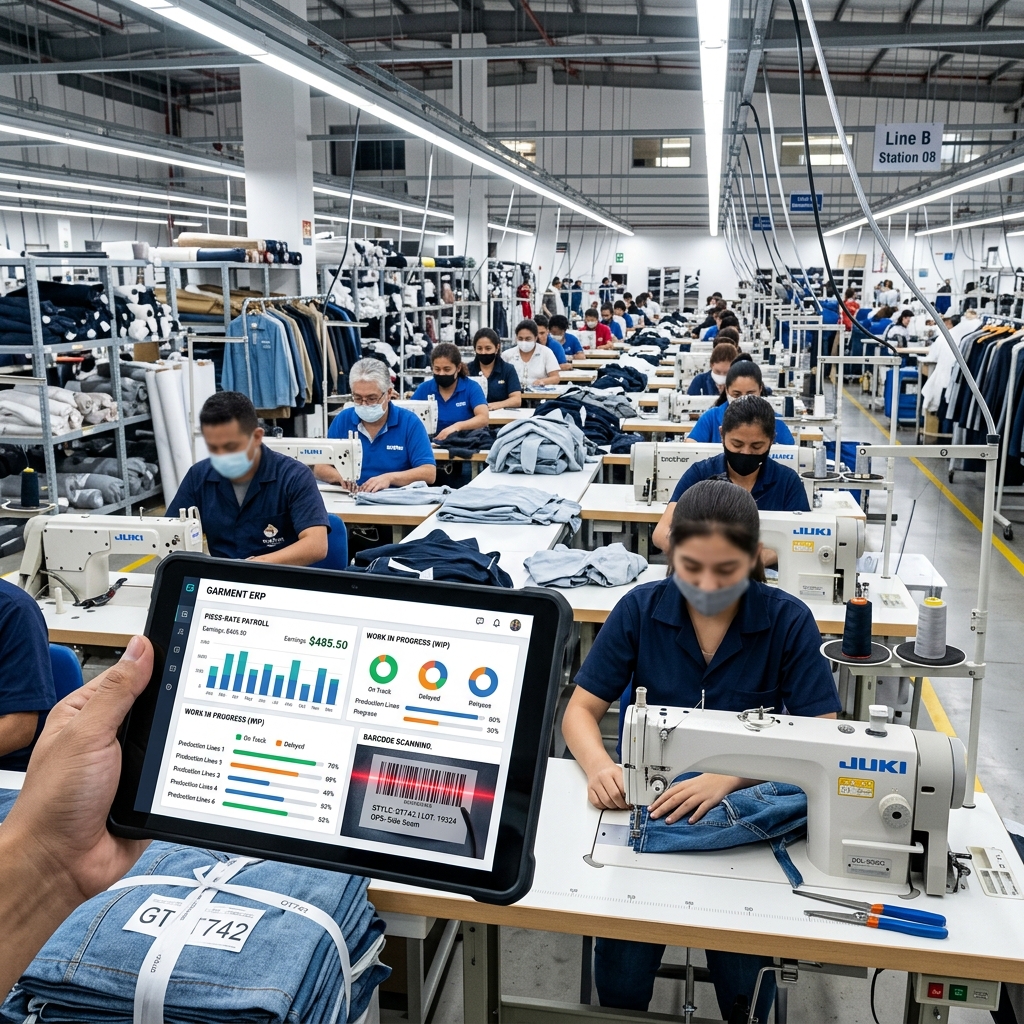
- ERP AI + MES AI Resolution: Shift-level operator production and quality declarations from MES AI synchronize directly into the HR & Payroll Management System, generating an objective 6-month KPI scorecard for mid-year bonuses and skill-upgrading programs.
5. Frequently Asked Questions (FAQ) on the June 30, 2027 Mid-Year Review, OEE, and BOM/MRP
Q1: Why should manufacturing plants recalibrate BOM and Routing master data specifically at the June 30, 2027 mid-year mark?
Answer: Over the first six months of operation, tooling upgrades, operator learning curves, and raw material batch characteristics often cause actual consumption and cycle times to diverge from January baseline budgets. Recalibrating BOM and Routing standards at the June 30, 2027 mid-year close aligns Standard Costing with reality and ensures Q3–Q4 MRP runs procure exact material quantities.
Q2: Why is IoT-connected MES AI OEE tracking far more reliable than manual Excel OEE reports?
Answer: Manual shift logs routinely omit micro-stoppages lasting 1 to 5 minutes or lump diverse downtime events into generic categories at shift end, artificially inflating reported OEE. Conversely, IoT sensors connected to MES AI capture every second of machine runtime, idle states, and cycle-speed drops directly from PLC controllers, providing 100% objective telemetry.
Q3: How can a factory complete its June 30, 2027 mid-year WIP inventory count without shutting down lines for 2–3 days?
Answer: Because every semi-finished batch carries a QR or RFID traveler tag scanned at each work center on MES AI Software, the system maintains real-time visibility into exact quantities and routing stages across the shop floor. On June 30, 2027, accountants simply extract a digital Point-in-Time WIP Snapshot and perform rapid spot-check verifications within hours.
Q4: How do mid-year inventory and WIP counts from MES AI synchronize with SAP ERP for interim financial reporting?
Answer: Verified counts for raw materials (Account 152), tools and supplies (Account 153), Work-in-Progress (Account 154), and finished goods (Account 155) synchronize directly from WMS/MES into SAP ERP Finance via the Service Layer API—ensuring full compliance with Circular 200/2014/TT-BTC for mid-year auditor review.
Q5: Once H1/2027 OEE reports identify a chronic bottleneck work center, how does APS resolve it for H2/2027?
Answer: Planners configure Drum-Buffer-Rope or bottleneck-priority scheduling rules inside the APS engine, enable automated lot-splitting across qualified alternate machines, and optimize setup sequences so the bottleneck asset maximizes productive spindle/press hours throughout Q3 and Q4/2027.
6. Official Technical & Regulatory References
- Enterprise ERP, BOM & MRP Documentation: SAP Business One Help Portal – Production Bill of Materials (BOM), Material Requirements Planning (MRP) & Inventory Counting (
https://help.sap.com/docs/SAP_BUSINESS_ONE). - MES, APS & OEE Technical Documentation: Boyum IT Solutions – Beas Manufacturing Documentation: Overall Equipment Effectiveness (OEE), APS Finite Scheduling & WIP Valuation (
https://www.boyum-solutions.com/solutions/production/beas-manufacturing). - Vietnamese Interim Accounting Standard: Circular No. 200/2014/TT-BTC dated December 22, 2014 by the Ministry of Finance guiding the Corporate Accounting Regime (Inventory physical counts, Account 154 WIP valuation, and Interim Financial Statements).
🔗 Explore InfoAsia Smart Factory & Enterprise Solutions (SAP Gold Partner Ecosystem):
- MES Software (Manufacturing Execution System) — Real-Time Shop Floor Control & OEE
- SAP Business One & SAP MES Integration for Smart Factories
- APS (Advanced Planning & Scheduling) — Automated Production Optimization
- Smart Warehouse Management (WMS / Barcode / RFID Traceability)
- Contact InfoAsia Experts for a Free 1-on-1 Live System Demo

InfoAsia Việt Nam trở thành nhà cung cấp dịch vụ phần mềm số hóa nhà máy sản xuất cho thương hiệu giày hàng đầu thế giới NEW BALANCE
Công ty TNHH Mây Tre Hà Linh
SAP ERP MES and IOT Project for FVIV Factor
Buwon Industry Co, Ltd
KANGLONGDA VIETNAM PROTECTION TECHNOLOGY COMPANY LIMITED
Shini Group
TA TING PLASTIC (HAI DUONG ) CO., LTD
CÔNG TY TNHH MTV BIÊN HOA SCM