




Key Takeaways:
- National May 2027 Safety Milestone: Every May (May 1 to May 31, 2027) marks Vietnam’s national Action Month on Occupational Safety and Health (OSH) pursuant to the Law on Occupational Safety and Health No. 84/2015/QH13 and Prime Minister’s Decision No. 87/QD-TTg.
- From Passive Inspections to Active IoT & MES AI Prevention: Moving beyond static banners, 2027 smart factories deploy industrial IoT sensor networks paired with MES AI Software to monitor motor temperatures, spindle vibrations, hydraulic pressures, and optical safety curtains in real time.
- Hard-Locked Safety Certification Verification at Workstations: Integrating OSH training records from the HR System directly with Production Management Software terminals prevents uncertified or expired-card operators from starting hazardous machinery.
- Predictive Maintenance Protects Both Workers and OEE: Detecting micro-anomalies before catastrophic equipment failure eliminates workplace injury hazards while safeguarding plant OEE (Overall Equipment Effectiveness).
- Automated PPE & Maintenance Cost Governance in SAP ERP: Centralizes statutory inspection schedules for pressure vessels and cranes, tracks Personal Protective Equipment (PPE) issuance, and allocates maintenance expenses accurately under Circular 200/2014/TT-BTC.
1. Strategic Importance of Occupational Safety & Health Action Month (May 2027) in Modern Manufacturing
Under the Law on Occupational Safety and Health No. 84/2015/QH13 and Decision No. 87/QD-TTg, May is designated annually as Vietnam’s National Action Month on Occupational Safety and Health to elevate workplace safety standards and prevent industrial accidents. In 2027 (Saturday, May 1 through Monday, May 31, 2027), this campaign coincides with the onset of intense early-summer heat across Northern and Central industrial zones and seasonal thunderstorms in the South—heightening risks of electrical cabinet overheating, chemical vapor volatility, and operator heat fatigue.
For factories operating high-tonnage stamping presses, die-casting furnaces, plastic injection lines, woodworking machinery, and automated packaging lines, a single equipment safety incident not only endangers human life but also halts production for days, triggering export delivery penalties and failing international ESG/CSR buyer audits.
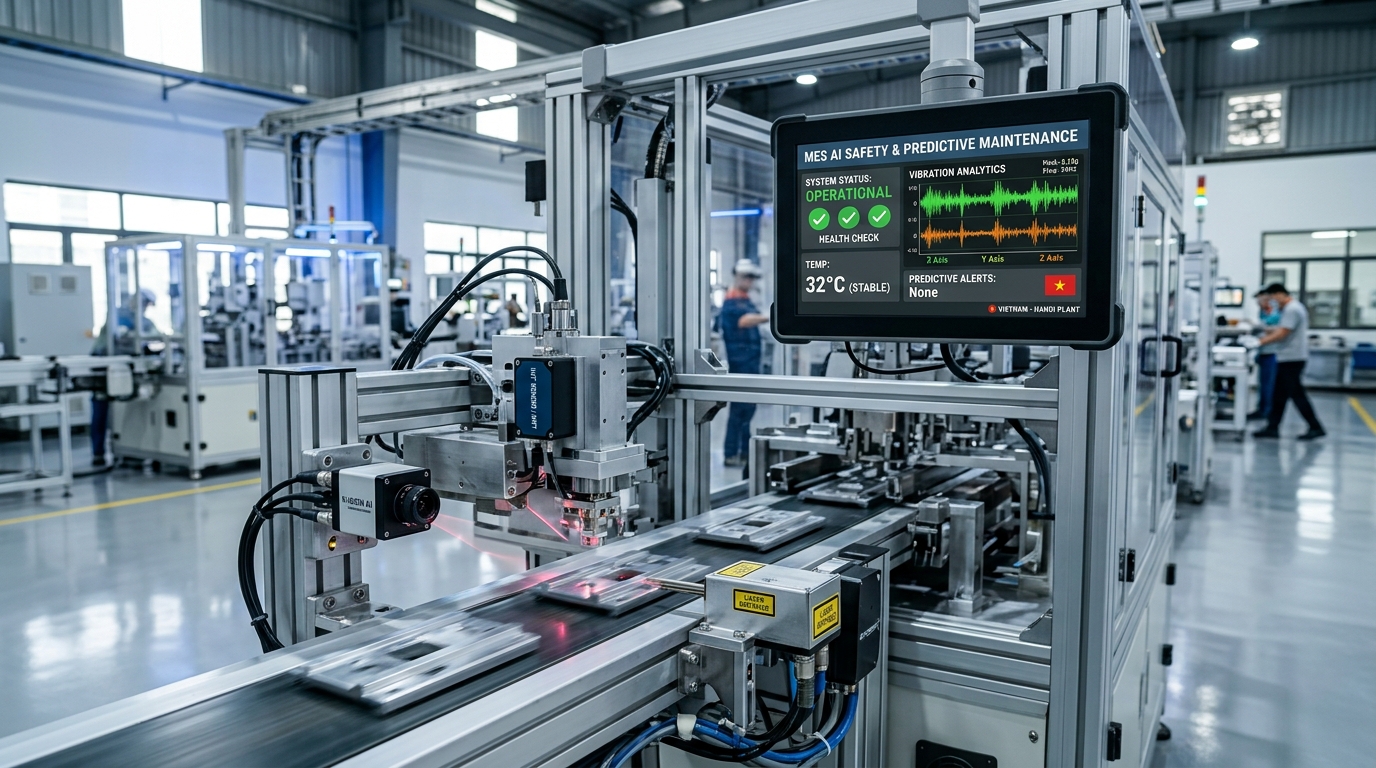
Consequently, forward-thinking manufacturers in May 2027 are transforming safety management into a continuous digital discipline powered by three integrated pillars: Industrial IoT Sensors – MES AI Software – SAP ERP & HR Governance.
2. Comparing Factory Safety & Equipment Maintenance Paradigms: Traditional vs. IoT + MES AI (2027)
| OSH & Maintenance Control Dimension | Traditional Approach (Paper Checklists & Periodic Visual Rounds) | 2027 Smart Factory Ecosystem (IoT + MES AI + SAP ERP + HR) |
|---|---|---|
| Monitoring Critical Machine Telemetry (Temperature, Pressure, Vibration) | Maintenance technicians perform manual rounds with handheld gauges 1–2 times per shift; misses mid-shift thermal spikes. | IoT sensors stream second-by-second telemetry to MES AI Software, triggering automated safety interlocks and red Andon alerts upon threshold breach. |
| Operator Safety Certification Enforcement at Dispatch | Supervisors assign operators from memory; risks placing uncertified or expired-card workers on stamping presses or forklifts. | When an operator badges in at a MES AI terminal, the system verifies active Group 3 OSH certification from the HR module before unlocking machine controls. |
| Statutory Inspection Tracking for Strict-Requirement Equipment (Boilers, Pressure Vessels, Cranes) | Tracked on isolated HSE spreadsheets; risks missed re-inspection deadlines during peak order seasons. | Asset records in SAP ERP and APS issue automated 30-day advance alerts and lock production scheduling on equipment with expired safety certificates. |
| Personal Protective Equipment (PPE) Issuance & Lifespan | Manual paper sign-off logs; difficult to enforce role-based replacement cycles for safety shoes, respirators, and goggles. | Role-based PPE entitlements managed across HR and SAP ERP inventory, with automated reorder and replacement notifications. |
| Equipment Maintenance Strategy | Reactive Run-to-Failure maintenance, causing sudden line breakdowns and mechanical hazard exposure. | Predictive Maintenance driven by MES AI anomaly detection and scheduled seamlessly into APS capacity calendars. |
3. Three Core Applications of the IoT – MES AI – SAP ERP Ecosystem During May 2027 Safety Month
3.1. Early Anomaly Detection and Predictive Maintenance via Industrial IoT & MES AI
By deploying MES & Industrial IoT Production Management Software, CNC machining centers, progressive stamping presses, industrial boilers, and air compressors are equipped with triaxial vibration sensors, current transformers (CT), and infrared thermal probes. MES AI machine-learning models establish baseline operating signatures for each work center, identifying bearing wear, shaft misalignment, or electrical overload days before a hazardous mechanical breakdown can occur.
3.2. Automated Skill Matrix and Safety Card Validation at Shop-Floor Terminals
Under the Law on Occupational Safety and Health 2015 and Decree 44/2016/ND-CP, workers operating equipment with strict safety requirements must hold valid OSH Safety Cards. By integrating the HR & Payroll Management System directly with shop-floor HMI tablets, MES Software validates both technical Skill Matrix qualifications and active OSH certificate expiration dates every time an operator logs into a workstation.
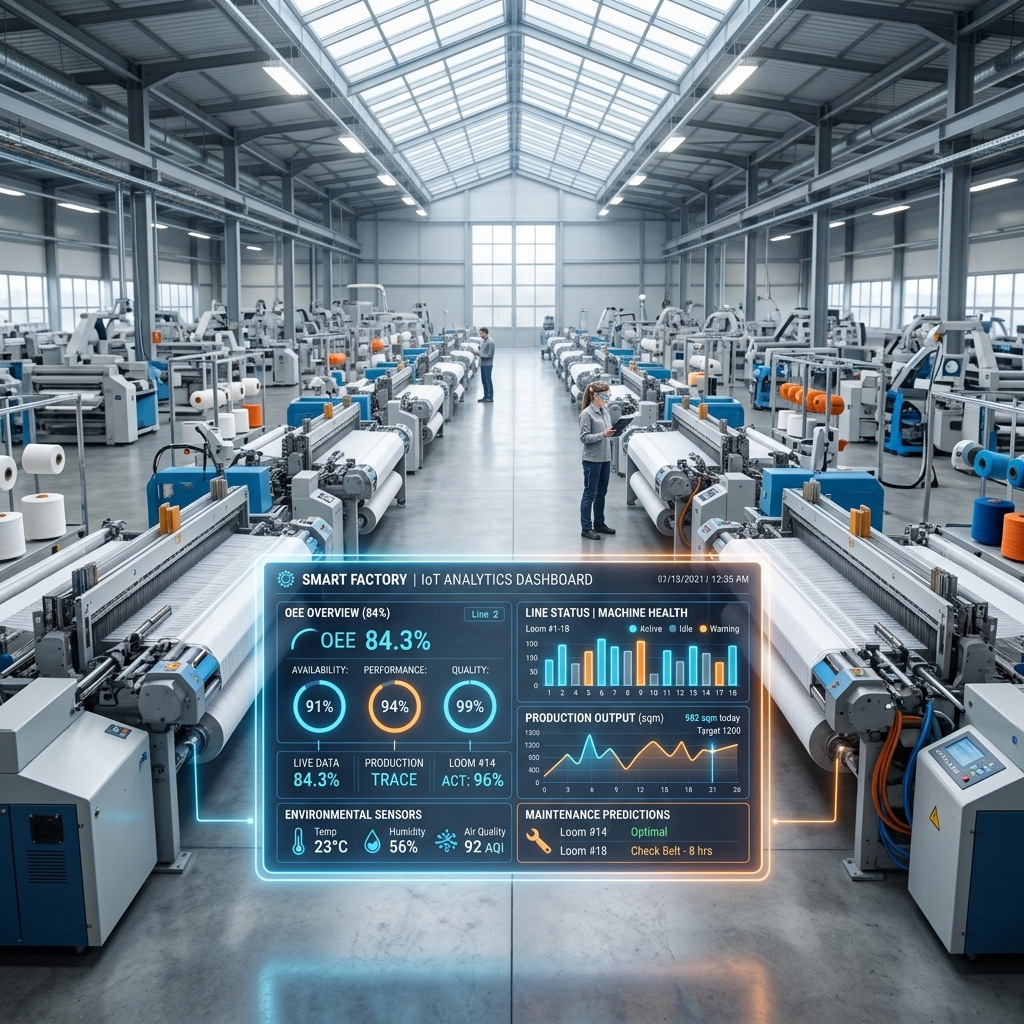
3.3. Digital Pre-Shift 5S & Safety Interlock Checklists
Replacing paper clipboards hanging beside machines, operators complete a mandatory 5-Point Digital Pre-Shift Safety Checklist (verifying Emergency Stop buttons, optical safety light curtains, lubrication pressure, electrical grounding, and required PPE) on industrial tablets powered by InfoAsia’s Cloud ERP – MES Integration. A Production Order can transition to Running status only after all safety checks register Pass.
4. Five Real-World IoT & MES AI Factory Safety Scenarios for May 2027 (What-If Simulation)
- [Illustrative Simulation Scenario – What-If Simulation] Preventing Inverter Cabinet Overheating on a 450-Ton Injection Molding Press During a May 2027 Heatwave:
- Context: During a midday heatwave in May 2027, ambient workshop temperatures reach 39°C, degrading cooling efficiency inside the variable-frequency drive (VFD) cabinet of a 450-ton molding press and risking an electrical fire.
- ERP AI + MES AI Resolution: An internal IoT thermal probe detects cabinet temperature crossing the 65°C yellow warning threshold and alerts MES AI. The system immediately sounds an Andon alarm in the electrical maintenance room and instructs the press controller to execute a controlled cycle-end stop, preventing inverter burnout and fire hazards.
- [Illustrative Simulation Scenario – What-If Simulation] Blocking Forklift Dispatch When an Operator’s Group 3 Safety Card Expires:
- Context: A warehouse forklift driver’s statutory Group 3 OSH safety card expires on
May 10, 2027, prior to completing the scheduled refresher training session. - ERP AI + MES AI Resolution: On the morning of
May 11, 2027, when the driver logs into the handheld WMS PDA connected to SAP ERP and HR, the system automatically blocks forklift task confirmation and notifies the Warehouse Supervisor and HSE Officer to assign a certified backup driver.
- Context: A warehouse forklift driver’s statutory Group 3 OSH safety card expires on
- [Illustrative Simulation Scenario – What-If Simulation] Scheduling Statutory Pressure Vessel and Overhead Crane Inspections in APS Without Delaying Orders:
- Context: Three central compressed-air receivers and two 10-ton overhead cranes in a heavy fabrication workshop require mandatory periodic safety inspection during the third week of May 2027.
- ERP AI + MES AI Resolution: The maintenance module in SAP ERP syncs statutory inspection dates directly into the APS Gantt schedule. APS automatically prioritizes heavy fabrication batches requiring crane lifting to finish by Friday (
May 21, 2027) and locks crane capacity on Saturday (May 22, 2027) for safe third-party certification testing.
- [Illustrative Simulation Scenario – What-If Simulation] Instant Safety Lockout Upon Detecting a Faulty Optical Light Curtain at Shift Start:
- Context: During the morning pre-shift check on a MES AI HMI tablet, a stamping press operator notices delayed beam response on the optical hand-protection curtain.
- ERP AI + MES AI Resolution: The operator taps Fail – Safety Sensor Fault on the terminal. MES Software immediately places the press into Safety Lockout (blocking work-order execution), illuminates the red tower light, and dispatches an urgent breakdown ticket to the nearest automation engineer’s mobile device.
- [Illustrative Simulation Scenario – What-If Simulation] Automated MRP Replenishment and Cost Allocation for Summer PPE Gear:
- Context: Launching the May 2027 OSH Action Month campaign, a factory needs to issue 600 sets of breathable flame-retardant uniforms, steel-toe boots, and ear protection across four workshops.
- ERP AI + MES AI Resolution: Based on role-specific PPE entitlements stored in HR, the MRP engine in SAP ERP checks safety-gear stock levels, generates Purchase Requests for shortfall quantities, and allocates PPE expenses accurately to each workshop’s Cost Center upon barcode issuance.
5. Frequently Asked Questions (FAQ) on IoT & MES AI in May 2027 Safety Month
Q1: When does Vietnam’s National Action Month on Occupational Safety and Health take place in 2027, and what is its legal basis?
Answer: Pursuant to the Law on Occupational Safety and Health No. 84/2015/QH13 and Prime Minister’s Decision No. 87/QD-TTg, the National Action Month on Occupational Safety and Health is observed annually nationwide from May 1 to May 31 (May 1 – May 31, 2027).
Q2: How do Industrial IoT and MES AI actively prevent workplace accidents on shop-floor machinery?
Answer: The platform enforces three digital safety layers: First, mandatory completion of digital pre-shift safety checklists on station HMI tablets before unlocking work orders; Second, real-time verification of operator OSH safety cards and skill certifications from the HR database; Third, continuous IoT telemetry monitoring (temperature, vibration, current, optical curtains) that triggers automated safety stops before hazardous failures occur.
Q3: How does MES AI Predictive Maintenance differ from traditional time-based preventive maintenance?
Answer: Traditional preventive maintenance services machines on fixed calendar intervals (e.g., every 3 or 6 months), which can either waste serviceable parts early or fail to catch rapid wear during heavy production runs. MES AI Predictive Maintenance analyzes actual machine cycle counts and live IoT vibration/thermal signatures to forecast component degradation accurately—scheduling maintenance right before failure occurs.
Q4: How can HSE safety inspections and maintenance windows be scheduled without clashing with urgent customer deliveries?
Answer: When maintenance or HSE teams log statutory inspection or preventive maintenance orders, those machine downtime windows synchronize automatically onto the APS finite-capacity Gantt chart. Planners immediately see locked maintenance blocks and can route urgent orders to alternate qualified machines without scheduling conflicts.
Q5: How are Personal Protective Equipment (PPE) and statutory machine inspection costs accounted for in SAP ERP?
Answer: Under Circular 200/2014/TT-BTC, shop-floor PPE issuances and statutory equipment safety inspection expenses are recorded under Account 627 (Manufacturing Overhead) by workshop cost center, subsequently absorbed into Work-in-Progress / Product Costing (Account 154), and recognized as deductible business expenses for Corporate Income Tax purposes.
6. Official Regulatory & Technical References
- Occupational Safety & Health Legislation: Law on Occupational Safety and Health No. 84/2015/QH13 passed by the National Assembly on June 25, 2015; Decree No. 44/2016/ND-CP detailing technical safety inspection and mandatory OSH training; Prime Minister’s Decision No. 87/QD-TTg establishing May as National OSH Action Month.
- Corporate Accounting Standard: Circular No. 200/2014/TT-BTC dated December 22, 2014 by the Ministry of Finance guiding the Corporate Accounting Regime.
- Enterprise ERP & MES/IoT Documentation: SAP Business One Help Portal (
https://help.sap.com/docs/SAP_BUSINESS_ONE) & Boyum IT Solutions – Beas Manufacturing Maintenance & Shop-Floor Control Documentation (https://www.boyum-solutions.com/solutions/production/beas-manufacturing).
🔗 Explore InfoAsia Smart Factory & Enterprise Solutions (SAP Gold Partner Ecosystem):
- MES Software (Manufacturing Execution System) — Real-Time Shop Floor Control & OEE
- SAP Business One & SAP MES Integration for Smart Factories
- APS (Advanced Planning & Scheduling) — Automated Production Optimization
- Smart Warehouse Management (WMS / Barcode / RFID Traceability)
- Contact InfoAsia Experts for a Free 1-on-1 Live System Demo

InfoAsia Việt Nam trở thành nhà cung cấp dịch vụ phần mềm số hóa nhà máy sản xuất cho thương hiệu giày hàng đầu thế giới NEW BALANCE
Công ty TNHH Mây Tre Hà Linh
SAP ERP MES and IOT Project for FVIV Factor
Buwon Industry Co, Ltd
KANGLONGDA VIETNAM PROTECTION TECHNOLOGY COMPANY LIMITED
Shini Group
TA TING PLASTIC (HAI DUONG ) CO., LTD
CÔNG TY TNHH MTV BIÊN HOA SCM